Tuesday, 21 December 2021

Fr Hunwicke's Mutual Enrichment: Anglican Orders

Fr Hunwicke's Mutual Enrichment: Anglican Orders

Anglican Orders

  Since there have been some meetings in Rome in which a call has been made for 'Rome' to reconsider the matter of Anglican Orders, perhaps I might offer one or two remarks.

Firstly: I suspect the motives of those involved. Possibly, some of them hope to set aside the negative judgement of S John Paul about the 'ordination' of women. Because, believe me, if Rome were suddenly to say "OK; we accept male Anglican priests" the discrimination involved in this would cause a great wave of anti-Roman animus in Anglicanism which would trump even the anti-Romanism of the 1500s. 

So this iniative is probably an oblique move to subvert the Church's teaching on the impossibility of women validly receiving the Sacrament of Order.

Secondly: since Anglicans officially (see below) accept the equivalence of their ministries with those of the Protestant ecclesial bodies, it would be illogical for the Catholic Church to accept Anglican Orders while continuing to reject the ministries of Protestant ecclesial bodies.

So this initiative is probably an oblique way of subverting the entire teaching of the Catholic Tradition on the Sacrament of Holy Order.

Thirdly: We need to recall exactly where we currently are in regard to Anglican Orders.

(1) It was the view of pope Leo XIII that Anglican Orders were null and void, in the sense that they were not identical with the sacerdotal Orders which the Church considers herself to inherit from the Apostles. That is still the official juridical view of the Catholic Church.

(2) What is often not noticed is that this is also now the view of the Church of England.  Since the 1990s, the Church of England has entered into formal relationships with ecclesial bodies which undoubtedly lack Catholic Orders. The 'Porvoo' arrangement inserts her into the Porvoo Communion in which, even where there is a quasi-episcopal structure, that 'episcopate', in Norway and Denmark, can make no claim to Apostolic Succession (as Professor Tighe has demonstrated, the same is almost certainly true even of the Swedish Church, of which more optimistic judgements had previously been officially made by the Church of England). And ordinations in Scandinavia are not exclusively performed by Bishops (but sometimes by cathedral deans). (It is also worth looking at the published text of the Anglican-Methodist Covenant, in which, instead of even a perfunctory attempt to show that the Methodists believe the same as Anglicans about Holy Order, there is ... believe it or not!! ... a cheerful assurance for Methodists that Anglicans don't believe anything different from what Methodist legal documents teach in their careful repudiation of a sacerdotal priesthood!)

(3) Faced with a very similar threat in the 1940s (at that time, the threat was posed by the 'CSI', a proposed pan-Protestant body called the Church of South India), Dom Gregory Dix, a robust defender of the validity of Anglican Orders, wrote: "As regards the question of Orders, what these proposals amount to is an official Anglican admission that Pope Leo XIII was right after all in his fundamental contention in Apostolicae Curae. In spite of face-saving phrases about 'the Apostolic Ministry' and the future confining of the act of Ordaining to men styled 'Bishops' [in fact, the Porvoo Scandinavians did not even undertake this], we would be committed to a formal declaration that by 'Bishops, Priests, and Deacons' could be meant only the new sixteenth-century conception of the Ministry disguised under the old titles ... And, whether we like it or not, that would be to justify Leo XIII in the teeth of all our own past history. Thus, if these proposals were to be put into practice, the whole ground for believing in the the Church of England which I have outlined would have ceased to exist ... "

(4) The other major Anglican theologian who mounted a persuasive defence of Anglican Orders was Dr Eric Mascall. He wrote: "When the preface to the Anglican ordinal declared that its purpose was the continuation of the threefold ministry which had existed 'from the Apostles' time', it was pointing to a concrete recognisable entity ... there was a lot to be said for avoiding theoretical statements ... and for pointing instead to the concrete reality which it was intended to perpetuate ... To the question 'what does ordination effect?' the fundamental answer is given ... by pointing to priests. ... defining it by telling you where it is and inviting you to go and look at it."

Well, the Church of England has, since the 1990s, certainly made quite a business of pointing to concrete realities and defining her views on priesthood by telling us where it is and inviting us to go and look at it. And where her formal, synodical pointing finger points to is to Denmark and Norway and Sweden.

(5) But Scandinavia is a long, long, long way ... well, perhaps not so very far away. But Scotland is undoubtedly even closer. And the "Columba agreement" ...  We all know how "Columba" will end: another of these concordats the essential meaning of which will be that Anglican priests are identical to Protestant ministers; that an ecclesial body without an episcopal polity is no less "Church" than a body that thinks it has one. The Church of England has been saying this, ever more often, with greater force, and with regard to geographically closer or more significant bodies, ever since the poor little Jerusalem Bishopric so upset S John Henry Newman ... through South India in the 1950s ... and Scandinavia in the 1990s. How many times does the C of E have to say the same thing before those of its members who call themselves "Catholics" realise that it really does mean what it keeps on and on saying?


Porvoo, not the ordination of women, was the point at which I realised that the Church of England was not a body in which I could have a permanent home; after that, the practical question was simply how to get out, acting corporately rather than as an individual; a question so graciously answered by Benedict XVI.  

The Church of England officially agrees with the judgment that Leo XIII made, that its orders are no different from the orders of all the Protestant bodies. Those who retain a Catholic doctrine of Holy Order, and still remain in the Church of England, can only do so by saying that the Church of England, and Leo XIII, were both wrong; and that "I understand Catholic teaching about Sacramental validity better than did Leo XIII; and, although the C of E says that its ministry is equivalent to Protestant ministries, I know better."

Logically tenable ... but what a very uncomfortably ego contra mundum position to hold! I know, because I've been there!

New Liturgical Movement: Notre Dame 2.0 and Missale Romanum 2.0

New Liturgical Movement: Notre Dame 2.0 and Missale Romanum 2.0

Notre Dame 2.0 and Missale Romanum 2.0

Notre Dame Cathedral has once again been in the news quite a bit. (I promise my readers that this article will come around to the subject on all of our minds, namely, the attack on the Roman Rite that was intensified by the CDW document released this past Saturday.) On the side of good news, Sharon Kabel at OnePeterFive takes us through the wondrous things happening in the course of Notre Dame's painstaking structural restoration, in the categories of wood, acoustics, metal, glass, stone, structure, digital, and emotion. What a building and what a project! The artisans, art historians, and craftsmen obviously love the medieval masterpiece that they are privileged to study and repair. On the side of bad news, Auguste Meyrat at Crisis tells us that (surprise, surprise) Catholic churchmen are in cahoots with liturgical and artistic modernists to produce an interior of hair-raising horror. Jeanne Smits, the Paris correspondent of LifeSiteNews, furnishes details about the plan, which apparently has received preliminary approval, in spite of the impassioned protest of over a hundred major French cultural figures. One can only hope and pray that better counsels will prevail, as they did for the replacement of the spire and the outside renovation.

In an interesting article published last April at PrayTell, James Hadley made a brilliant case for architectural traditionalism and against artistic modernism. He quotes Jorge Otero-Pailos, Director and Professor of Historic Preservation at Columbia University Graduate School of Architecture, Planning and Preservation, who said that "heritage is a social process of making and remaking culture by interacting in and with sites and objects inherited with previous generations." Hadley comments:
While this in part is true, it also wrongly gives the impression that both heritage and culture are things we create based upon what we value or dis-value at any given moment. It implies that heritage has no inherent force or stability by which we "should" value it. As a result, contemporary society is left unfettered to destroy or remake past monuments as we see fit. We are simply playing at making new transient meanings and values based upon our shifting priorities and allegiances at the moment.
He then turns to the Vatican's Pontificia Commissione per i Beni Culturali della Chiesa for guidance. The commission's body of directives on how old ecclesiastical buildings should be treated
understands ecclesiastical heritage not firstly as high artistic achievement, but as material witness to Christian belief. The object itself (be it a sculpture or building) expresses Christian belief, but more importantly, it records and projects the faith of the community which created it – it is the witness of the witnesses. Christian heritage is theologically rooted therefore in those who have seen and confessed Christ as Lord, and is theologically oriented to continuing that witness in the present. In this way, the pertinent question for church heritage is not how may we act upon it to our own ends, but how may we become present to its inner world of meaning, what in Italian is known as valorizzazione. In this paradigm there is a very real sense of communio with and between the present church, the object, and the Christian community of the past. To tamper with the material object, is to change the record of witness. A communion suggests respect, listening, and investigation. Not hubris, hegemony, and alteration. Oddly, no one would contend that in order to understand the past and make it relevant one should enter an archive and rewrite, erase or destroy documents. But this is exactly what we continuously do in the built environment (our church buildings bearing the brunt), and in so doing we falsify and destroy the underlying witness. In this process of alteration we ultimately erase ourselves since we are constantly born out of our pasts.
Hadley notes that most of the proponents of super-modern renovations to Notre Dame (thankfully all rejected) believe that moderns are inescapably stuck in modernity and cannot relate any more to past styles as if they were present languages. Citing Catholics who believe that the right approach is to "innovate for God," to show that the community has something "new" to say, he remarks:
In a post-Christian West the necessary reflection called for by the Notre-Dame tragedy is not a question of "innovation" but of reclamation and witness. Reclaiming and fortifying our witness by understanding our past. When the fire broke out at the cathedral, the nearby monastic Fraternité de Jérusalem began signing the Litany of Saints in their church invoking the aid of French Christians of old whose faith had built Notre-Dame. They continued the litany until the flames were extinguished…. What I see at stake now is the preservation of the very possibility of religious imagination. It seems to me that what Christianity should be proposing at this time is not "innovation" but deep engagement with our past, by calling upon the people, faith, and wisdom, that created that which we postmodernists are now playing at. After all, the term innovate in its earlier Latin form meant more to "renew" than to "change." One is hard pressed to innovate with empty hands. We need our architectural and artistic past and we need to relearn it urgently.
The end of Hadley's article is an eloquent appeal to abandon modern hubris and to sit at the feet of our ancestors in the Faith, who have something to teach us, who have indeed much to tell us that we have forgotten, to our impoverishment. Perhaps most of all, we need to be broken out of our temporal snobbery and the hidden heresy of perpetual progress. Every age is an age of progress, regress, and stasis, in different respects; and yet the most important truths, the truths by which we live and die, remain the same.
It now must be said again explicitly; Our ancestors, histories, material cultures, and built environments, have the right to be what they are. To not be re-interpreted, or reinvented. To exist today in their integrity without our pushy or hubristic updates, additions, and re-contextualization meant to sooth, temporarily mesmerize, or aggrandize ourselves… What this demands of us is humility, recognition that we are not inherently progressive in any positive way, that modernity is not innately better, that the junk we flood the earth with today, is not more enduring and meaningful than the artistry and faith of our past. We like the Russian Orthodox reformer of the 19th century, Ivan Kireevsky, cannot insist that the way forward is to change a past because we have forgotten it (Kireevsky, Fragments, 248-43). We must instead go to that place our ancestors built and learn to see it as they did, and thus bear testimony to it as eyewitnesses. And such is the case of Notre-Dame in Paris. Its restoration lies not in our changes to it, but in our submission to its form, wisdom, and witness.

Could anyone read this impassioned plea for preserving the architectural integrity of Notre Dame cathedral and not think immediately of the even greater claim made on us by the greatest work of art known to the Western world—the Roman Rite of the Mass, and its panoply of attendant rites—whose integrity was so violently assaulted after the Second Vatican Council? Just go back and re-read the quotations from Hadley, but having in mind the liturgy instead of Notre Dame. There is a nearly one-for-one equivalency of concept and praxis.

This, in turn, reminds me of one of the most splendid passages in the writings of John Senior:

Whatever we do in the political or social order, the indispensable foundation is prayer, the heart of which is the Holy Sacrifice of the Mass, the perfect prayer of Christ Himself, Priest and Victim, recreating in an unbloody manner the bloody, selfsame Sacrifice of Calvary. What is Christian culture? It is essentially the Mass.
       That is not my or anyone's opinion or theory or wish but the central fact of 2,000 years of history. Christendom, what secularists call Western Civilization, is the Mass and the paraphernalia which protect and facilitate it. All architecture, art, political and social forms, economics, the way people live and feel and think, music, literature―all these things, when they are right, are ways of fostering and protecting the Holy Sacrifice of the Mass.
       To enact a sacrifice, there must be an altar, an altar has to have a roof over it in case it rains; to reserve the Blessed Sacrament, we build a little House of Gold and over it a Tower of Ivory with a bell and a garden round it with the roses and lilies of purity, emblems of the Virgin Mary ―Rosa Mystica, Turris Davidica, Turris Eburnea, Domus Aurea, who carried His Body and His Blood in her womb, Body of her body, Blood of her blood.
       And around the church and garden, where we bury the faithful dead, the caretakers live, the priests and religious whose work is prayer, who keep the Mystery of Faith in its tabernacle of music and words in the Office of the Church; and around them, the faithful who gather to worship and divide the other work that must be done in order to make the perpetuation of the Sacrifice possible—to raise the food and make the clothes and build and keep the peace so that generations to come may live for Him, so that the Sacrifice goes on even until the consummation of the world.
The raging flames that burned up the spire and roof of the great medieval masterpiece of Notre-Dame in Paris, the fire that gutted its harmonious additions and renovations, provided us with a palpable image of what was done to that even greater masterpiece of medieval art (so to speak), the traditional Roman Rite, in the decade from about 1963 to 1973. The cathedral, after all, was created to house the Host and to provide a worthy space for the sacred liturgy. There would be no Notre Dame, no Chartres, not a single one of the great cathedrals, without the usus antiquior, as Marcel Proust recognized (see his important 1904 essay Death Comes for the Cathedrals, recently published by Wiseblood Books with commentary by John Pepino and me, tying it in to the traditionalist movement today).

It is therefore the very same instinct to wish to see Notre Dame restored to her glory and to wish to see the Roman liturgy restored to its glory; the same intuition that tells us there is something radically wrong with deconstructing and reconstructing our central act of prayer according to modernist or post-modernist proclivities.

Sunday, 19 December 2021

Additional Notes from @FatherZ on the Dubious Dubia concerning “Traditionis custodes” | Fr. Z's Blog

Additional Notes from @FatherZ on the Dubious Dubia concerning "Traditionis custodes" | Fr. Z's Blog

Additional Notes from @FatherZ on the Dubious Dubia concerning "Traditionis custodes"

My first reactions are HERE.

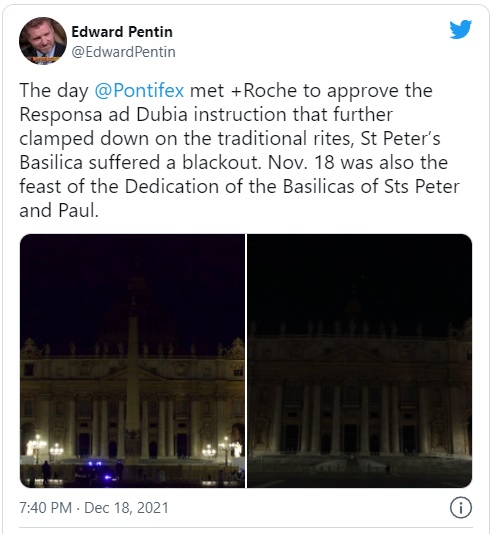
Note One.  The timing of these "responsa"… Merry Christmas everyone!   It's as if they wanted to hurt people even more by making these changes close to such an important day, bound up with Midnight Masses and so forth.  Ed Pentin pointed out that the day that Francis signed off on them, 18 November, was the Feast of the Dedication of the Basilicas of Sts. Peter and Paul, and on that very day there was a massive power outage that reduced St. Peter's to darkness.

Note Two.   Speaking of Midnight Masses, one of the "questions" (dubia) asked if a priest can binate (say Mass twice in a day) and therefore say a TLM.   The responsum (answer) was "Negative".  So, a priest who says the Novus Ordo during a 24 hour period, cannot then say the TLM later in the day.  Or, he can't say the TLM early and the Novus Ordo later.   That means that, if Father has his own parish and takes care of his schedule, but another parish that has the TLM scheduled needs a celebrant – perhaps the usual priest is ill – he cannot be that celebrant.  Screw you, "beloved faithful"!

Mind you, I am pretty sure that can. 87 still applies: Diocesan Bishops can still dispense from this … IF… IF these dubia have any force of law, and I am not entirely convinced that they do, at least not universally.  They were not published in forma specifica, for example.  Responses to dubia are singular administrative acts that apply to the ones who asked the question.  So, are they binding on everyone?  Either way, they indicate the direction the Congregation is going.

Note Three.  I ask you… who would put a question like that to the Congregation as a dubium?  Who would worry about bination, for cryin' out loud?  No.  The question was concocted from within the Congregation or in collaboration precisely in order to slam another door on people's outstretched hands.

Note Four.  One of the alleged dubia asked whether a priest who refuses to concelebrate, in particular the Chrism Mass, is allowed any concession to use the 1962 Missale at all.  Guess what the answer is.

Again… who would ask such a thing? Would a diocesan bishop?  I doubt it.  They have enough things to worry about apart from forcing priests to concelebrate.  This is the sort of question that would come from a pure ideologue, maybe an academic, obsessed with uniformity, willing or not.

Forcing the irrelevant side-issue of concelebration is like forcing a pinch of incense to the genius (divine guiding spirit) of the Emperor Domitian.   The cult of the genius of the Emperor was tantamount, but just short of, worshiping a living Emperor as a god.  Instead they offered worship to the Emperor's special tutelary demi-god.  Those who refused to worship of semi-detached divinity of the Emperor were considered atheists undermining the contractual peace relationship with the gods, the pax deorum, maintained through rituals.

The ideologues now forcing the issue of concelebration are like the officials at the time of Domitian forcing that pinch of incense, but now the genius of the Emperor is the "Spirit of Vatican II.

Note Five. An astute friends made this point about ordinations and the banning of the Pontificale Romanum.

Rituale yes, Pontificale no. VERY interesting. Cut the apostolic continuity of liturgy. The devil is doing this, in case you had any doubt.

Priests use the Rituale, but the Pontificale is used by pontifices, bishops.  My friend is onto something.  In making this move, the Congregation is attempting what the Enemy surely would do, if possible.

Frankly, that means that this is crunch-time for bishops who are a) friendly toward Tradition in an authentic way (not the way indicated in the tragically mislabeled TC)  or who are b) against pure and simple mean-spirited tyranny.   Priests will have to stand up, but bishops have to stand up too.

This is all a savage attack on the identity of bishops.

And I'll wager that a lot of bishops out there are muttering the maledictory psalms at the Congregation today.  These responses are going to cause bishops immense discomfort in their dioceses if they move to implement anything about them… and they should.

People need to step up in great numbers and not be anything like silent in the face of this oppression.  They must make their minds known and say what they are going to do or not do about it.  I am in no way suggesting anything lacking in charity.  As a matter of fact, I warmly counsel careful examination of conscience and frequent confession before acting on conviction.

Shutting up is not an option.   The issues are too important.

Note Six.  Next, there is always more that they can do to hurt people.  And they will do it, in time.

This is a lovely Christmas present from them.   That's how they roll.  According to the Fat Man's Laws of the House of God:

VIII. They can always hurt you more.

Keep looking down the line for the ways that they can hurt people.

My prediction is that their knives will now turn to the traditional groups like the FSSP and ICK, etc.   "Commissars" will be appointed over them, endowed with even to the point that they can unilaterally change the Constitutions of those groups.  Hence, the commissars will expunge from those groups the right to have ordinations with the traditional Pontificale Romanum.

Again, an attack on the identity of bishops.

Note Seven.  One of the responses says that – friends, I am not making this up – if a bishop can't find a church or chapel for the Vetus Ordo, can the bishop ask the Congregation for dispensation so that it can be at a parish church.  (Never mind that the bishop can apply can. 87 and do it himself.)  The response is "Affirmative" but goes on to say that – really, I am not making this up – "such a celebration should not be included in the parish Mass schedule".

The CDW now wants to regulate what is in parish bulletins?

One response to this on twitter was excellent:

Right after the Congregation's clown-car routine about not making the Mass know at the parish where it is taking place, is where we read…

There is no intention in these provisions to marginalise the faithful who are rooted in the previous form of celebration: they are only meant to remind them that this is a concession to provide for their good…

A woman friend who is involved in a Catholic publishing concern told me they remind her of how the "mean girls" acted in the High School bathroom.

Note Eight.  Which leads to another point.  I received this (slightly redacted) note:

It's not about the Liturgy. It's about traditional Church teaching against sodomy. Traditional liturgy is the visible "head out of the foxhole" for traditional teaching. And so they attack like terrorists – with paper decrees and faux dubia (interesting that there are some dubia that they are able to answer after all) and then run back into their safe spaces under baby milk factories and pre-schools, satisfied that they have triumphed over the oppressor. But like the other Romans two millennia ago as well as the Borg, they will learn that resistance is not futile and that Divine Truth always prevails.

This rings strongly with the truth.

Dominica IV Adventus ~ I. classis Ad Sextam 12-19-2021

Dominica IV Adventus ~ I. classis


Ad Sextam   12-19-2021

Incipit 
V. Deus ☩ in adiutórium meum inténde.
R. Dómine, ad adiuvándum me festína.
V. Glória Patri, et Fílio, * et Spirítui Sancto.
R. Sicut erat in princípio, et nunc, et semper, * et in sǽcula sæculórum. Amen.
Allelúia.
Start 
V. O God, ☩ come to my assistance;
R. O Lord, make haste to help me.
V. Glory be to the Father, and to the Son, * and to the Holy Ghost. 
R. As it was in the beginning, is now, * and ever shall be, world without end. Amen.
Alleluia.
Hymnus 
Rector potens, verax Deus,
Qui témperas rerum vices,
Splendóre mane illúminas,
Et ígnibus merídiem:

Exstíngue flammas lítium,
Aufer calórem nóxium,
Confer salútem córporum,
Verámque pacem córdium.

* Præsta, Pater piíssime,
Patríque compar Únice,
Cum Spíritu Paráclito
Regnans per omne sǽculum.
Amen.
Hymn 
O God of truth, O Lord of might,
Who orderest time and change aright,
Who send'st the early morning ray,
And light'st the glow of perfect day:

Extinguish thou each sinful fire,
And banish every ill desire;
And while thou keep'st the body whole,
Shed forth thy peace upon the soul.

* Almighty Father, hear our cry,
Through Jesus Christ, our Lord most High,
Who, with the Holy Ghost and thee,
Doth live and reign eternally.
Amen.
Psalmi {ex Proprio de Tempore} 
Ant. Erunt prava * in dirécta, et áspera in vias planas: veni, Dómine, et noli tardáre, allelúia.
Psalmus 118(81-96) [1]
118:81  (Caph) Defécit in salutáre tuum ánima mea: * et in verbum tuum supersperávi.
118:82 Defecérunt óculi mei in elóquium tuum, * dicéntes: Quando consoláberis me?
118:83 Quia factus sum sicut uter in pruína: * iustificatiónes tuas non sum oblítus.
118:84 Quot sunt dies servi tui? * quando fácies de persequéntibus me iudícium?
118:85 Narravérunt mihi iníqui fabulatiónes: * sed non ut lex tua.
118:86 Ómnia mandáta tua véritas: * iníque persecúti sunt me, ádiuva me.
118:87 Paulo minus consummavérunt me in terra: * ego autem non derelíqui mandáta tua.
118:88 Secúndum misericórdiam tuam vivífica me: * et custódiam testimónia oris tui.
118:89  (Laméd) In ætérnum, Dómine, * verbum tuum pérmanet in cælo.
118:90 In generatiónem et generatiónem véritas tua: * fundásti terram, et pérmanet.
118:91 Ordinatióne tua persevérat dies: * quóniam ómnia sérviunt tibi.
118:92 Nisi quod lex tua meditátio mea est: * tunc forte periíssem in humilitáte mea.
118:93 In ætérnum non oblivíscar iustificatiónes tuas: * quia in ipsis vivificásti me.
118:94 Tuus sum ego, salvum me fac: * quóniam iustificatiónes tuas exquisívi.
118:95 Me exspectavérunt peccatóres ut pérderent me: * testimónia tua intelléxi.
118:96 Omnis consummatiónis vidi finem: * latum mandátum tuum nimis.
V. Glória Patri, et Fílio, * et Spirítui Sancto.
R. Sicut erat in princípio, et nunc, et semper, * et in sǽcula sæculórum. Amen.
Psalms {from the Proper of the season} 
Ant. The crooked * shall be made straight, and the rough places plain; O Lord, come, and make no tarrying. Alleluia.
Psalm 118(81-96) [1]
118:81  (Caph) My soul hath fainted after thy salvation: * and in thy word I have very much hoped.
118:82 My eyes have failed for thy word, * saying: When wilt thou comfort me?
118:83 For I am become like a bottle in the frost: * I have not forgotten thy justifications.
118:84 How many are the days of thy servant: * when wilt thou execute judgment on them that persecute me?
118:85 The wicked have told me fables: * but not as thy law.
118:86 All thy statutes are truth: * they have persecuted me unjustly, do thou help me.
118:87 They had almost made an end of me upon earth: * but I have not forsaken thy commandments.
118:88 Quicken thou me according to thy mercy: * and I shall keep the testimonies of thy mouth.
118:89  (Lamed) For ever, O Lord, * thy word standeth firm in heaven.
118:90 Thy truth unto all generations: * thou hast founded the earth, and it continueth.
118:91 By thy ordinance the day goeth on: * for all things serve thee.
118:92 Unless thy law had been my meditation, * I had then perhaps perished in my abjection.
118:93 Thy justifications I will never forget: * for by them thou hast given me life.
118:94 I am thine, save thou me: * for I have sought thy justifications.
118:95 The wicked have waited for me to destroy me: * but I have understood thy testimonies.
118:96 I have seen an end of all perfection: * thy commandment is exceeding broad.
V. Glory be to the Father, and to the Son, * and to the Holy Ghost. 
R. As it was in the beginning, is now, * and ever shall be, world without end. Amen.
Psalmus 118(97-112) [2]
118:97  (Mem) Quómodo diléxi legem tuam, Dómine? * tota die meditátio mea est.
118:98 Super inimícos meos prudéntem me fecísti mandáto tuo: * quia in ætérnum mihi est.
118:99 Super omnes docéntes me intelléxi: * quia testimónia tua meditátio mea est.
118:100 Super senes intelléxi: * quia mandáta tua quæsívi.
118:101 Ab omni via mala prohíbui pedes meos: * ut custódiam verba tua.
118:102 A iudíciis tuis non declinávi: * quia tu legem posuísti mihi.
118:103 Quam dúlcia fáucibus meis elóquia tua, * super mel ori meo!
118:104 A mandátis tuis intelléxi: * proptérea odívi omnem viam iniquitátis.
118:105  (Nun) Lucérna pédibus meis verbum tuum, * et lumen sémitis meis.
118:106 Iurávi, et státui * custodíre iudícia iustítiæ tuæ.
118:107 Humiliátus sum usquequáque, Dómine: * vivífica me secúndum verbum tuum.
118:108 Voluntária oris mei beneplácita fac, Dómine: * et iudícia tua doce me.
118:109 Ánima mea in mánibus meis semper: * et legem tuam non sum oblítus.
118:110 Posuérunt peccatóres láqueum mihi: * et de mandátis tuis non errávi.
118:111 Hereditáte acquisívi testimónia tua in ætérnum: * quia exsultátio cordis mei sunt.
118:112 Inclinávi cor meum ad faciéndas iustificatiónes tuas in ætérnum, * propter retributiónem.
V. Glória Patri, et Fílio, * et Spirítui Sancto.
R. Sicut erat in princípio, et nunc, et semper, * et in sǽcula sæculórum. Amen.
Psalm 118(97-112) [2]
118:97  (Mem) How have I loved thy law, O Lord! * it is my meditation all the day.
118:98 Through thy commandment, thou hast made me wiser than my enemies: * for it is ever with me.
118:99 I have understood more than all my teachers: * because thy testimonies are my meditation.
118:100 I have had understanding above ancients: * because I have sought thy commandments.
118:101 I have restrained my feet from every evil way: * that I may keep thy words.
118:102 I have not declined from thy judgments, * because thou hast set me a law.
118:103 How sweet are thy words to my palate! * more than honey to my mouth.
118:104 By thy commandments I have had understanding: * therefore have I hated every way of iniquity.
118:105  (Nun) Thy word is a lamp to my feet, * and a light to my paths.
118:106 I have sworn and am determined * to keep the judgments of thy justice.
118:107 I have been humbled, O Lord, exceedingly: * quicken thou me according to thy word.
118:108 The free offerings of my mouth make acceptable, O Lord: * and teach me thy judgments.
118:109 My soul is continually in my hands: * and I have not forgotten thy law.
118:110 Sinners have laid a snare for me: * but I have not erred from thy precepts.
118:111 I have purchased thy testimonies for an inheritance for ever: * because they are the joy of my heart.
118:112 I have inclined my heart to do thy justifications for ever, * for the reward.
V. Glory be to the Father, and to the Son, * and to the Holy Ghost. 
R. As it was in the beginning, is now, * and ever shall be, world without end. Amen.
Psalmus 118(113-128) [3]
118:113  (Samech) Iníquos ódio hábui: * et legem tuam diléxi.
118:114 Adiútor et suscéptor meus es tu: * et in verbum tuum supersperávi.
118:115 Declináte a me, malígni: * et scrutábor mandáta Dei mei.
118:116 Súscipe me secúndum elóquium tuum, et vivam: * et non confúndas me ab exspectatióne mea.
118:117 Ádiuva me, et salvus ero: * et meditábor in iustificatiónibus tuis semper.
118:118 Sprevísti omnes discedéntes a iudíciis tuis: * quia iniústa cogitátio eórum.
118:119 Prævaricántes reputávi omnes peccatóres terræ: * ídeo diléxi testimónia tua.
118:120 Confíge timóre tuo carnes meas: * a iudíciis enim tuis tímui.
118:121  (Ain) Feci iudícium et iustítiam: * non tradas me calumniántibus me.
118:122 Súscipe servum tuum in bonum: * non calumniéntur me supérbi.
118:123 Óculi mei defecérunt in salutáre tuum: * et in elóquium iustítiæ tuæ.
118:124 Fac cum servo tuo secúndum misericórdiam tuam: * et iustificatiónes tuas doce me.
118:125 Servus tuus sum ego: * da mihi intelléctum, ut sciam testimónia tua.
118:126 Tempus faciéndi, Dómine: * dissipavérunt legem tuam.
118:127 Ídeo diléxi mandáta tua, * super aurum et topázion.
118:128 Proptérea ad ómnia mandáta tua dirigébar: * omnem viam iníquam ódio hábui.
V. Glória Patri, et Fílio, * et Spirítui Sancto.
R. Sicut erat in princípio, et nunc, et semper, * et in sǽcula sæculórum. Amen.

Ant. Erunt prava in dirécta, et áspera in vias planas: veni, Dómine, et noli tardáre, allelúia.
Psalm 118(113-128) [3]
118:113  (Samech) I have hated the unjust: * and I have loved thy law.
118:114 Thou art my helper and my protector: * and in thy word I have greatly hoped.
118:115 Depart from me, ye malignant: * and I will search the commandments of my God.
118:116 Uphold me according to thy word, and I shall live: * and let me not be confounded in my expectation.
118:117 Help me, and I shall be saved: * and I will meditate always on thy justifications.
118:118 Thou hast despised all them that fall off from thy judgments; * for their thought is unjust.
118:119 I have accounted all the sinners of the earth prevaricators: * therefore have I loved thy testimonies.
118:120 Pierce thou my flesh with thy fear: * for I am afraid of thy judgments.
118:121  (Ain) I have done judgment and justice: * give me not up to them that slander me.
118:122 Uphold thy servant unto good: * let not the proud calumniate me.
118:123 My eyes have fainted after thy salvation: * and for the word of thy justice.
118:124 Deal with thy servant according to thy mercy: * and teach me thy justifications.
118:125 I am thy servant: * give me understanding that I may know thy testimonies.
118:126 It is time, O Lord, to do: * they have dissipated thy law.
118:127 Therefore have I loved thy commandments * above gold and the topaz.
118:128 Therefore was I directed to all thy commandments: * I have hated all wicked ways.
V. Glory be to the Father, and to the Son, * and to the Holy Ghost. 
R. As it was in the beginning, is now, * and ever shall be, world without end. Amen.

Ant. The crooked shall be made straight, and the rough places plain; O Lord, come, and make no tarrying. Alleluia.
Capitulum Responsorium Versus{ex Proprio de Tempore} 
1 Cor 4:3
Mihi autem pro mínimo est, ut a vobis iúdicer, aut ab humáno die: sed neque meípsum iúdico.
R. Deo grátias.

R.br. Osténde nobis, Dómine, * Misericórdiam tuam.
R. Osténde nobis, Dómine, * Misericórdiam tuam.
V. Et salutáre tuum da nobis.
R. Misericórdiam tuam.
V. Glória Patri, et Fílio, * et Spirítui Sancto.
R. Osténde nobis, Dómine, * Misericórdiam tuam.

V. Meménto nostri, Dómine, in beneplácito pópuli tui.
R. Vísita nos in salutári tuo.
Chapter Responsory Verse {from the Proper of the season} 
1 Cor 4:3
But to me it is a very small thing to be judged by you, or by man's day; but neither do I judge my own self.
R. Thanks be to God.

R.br. Show us, O Lord, * thy mercy.
R. Show us, O Lord, * thy mercy. 
V. And grant us thy salvation.
R. Thy mercy.
V. Glory be to the Father, and to the Son, * and to the Holy Ghost.
R. Show us, O Lord, * thy mercy.

V. Remember us, O Lord, in the favor of thy people.
R. Visit us with thy salvation.
Oratio {ex Proprio de Tempore} 
V. Dómine, exáudi oratiónem meam.
R. Et clamor meus ad te véniat.
Orémus.
Excita, quǽsumus, Dómine, poténtiam tuam, et veni: et magna nobis virtúte succúrre; ut per auxílium grátiæ tuæ, quod nostra peccáta præpédiunt, indulgéntia tuæ propitiatiónis accéleret:
Qui vivis et regnas cum Deo Patre, in unitáte Spíritus Sancti, Deus, per ómnia sǽcula sæculórum.
R. Amen.
Prayer {from the Proper of the season} 
V. O Lord, hear my prayer.
R. And let my cry come unto thee.
Let us pray.
Stir up, we beseech thee, O Lord, thy power, and come; make haste to our aid with thy great might; that, by the help of thy grace, that which is hindered by our sins may be hastened by thy merciful forgiveness.
Who livest and reignest with God the Father in the unity of the Holy Spirit, God, world without end.
R. Amen
Conclusio 
V. Dómine, exáudi oratiónem meam.
R. Et clamor meus ad te véniat.
V. Benedicámus Dómino.
R. Deo grátias.
V. Fidélium ánimæ per misericórdiam Dei requiéscant in pace.
R. Amen.
Conclusion 
V. O Lord, hear my prayer.
R. And let my cry come unto thee.
V. Let us bless the Lord.
R. Thanks be to God.
V. May the souls of the faithful, through the mercy of God, rest in peace.
R. Amen

Dominica IV Adventus ~ I. classis Ad Sextam 12-19-2021

Psalm 118(113-128) [3]
118:113  (Samech) I have hated the unjust: * and I have loved thy law.
118:114 Thou art my helper and my protector: * and in thy word I have greatly hoped.
118:115 Depart from me, ye malignant: * and I will search the commandments of my God.
118:116 Uphold me according to thy word, and I shall live: * and let me not be confounded in my expectation.
118:117 Help me, and I shall be saved: * and I will meditate always on thy justifications.
118:118 Thou hast despised all them that fall off from thy judgments; * for their thought is unjust.
118:119 I have accounted all the sinners of the earth prevaricators: * therefore have I loved thy testimonies.
118:120 Pierce thou my flesh with thy fear: * for I am afraid of thy judgments.
118:121  (Ain) I have done judgment and justice: * give me not up to them that slander me.
118:122 Uphold thy servant unto good: * let not the proud calumniate me.
118:123 My eyes have fainted after thy salvation: * and for the word of thy justice.
118:124 Deal with thy servant according to thy mercy: * and teach me thy justifications.
118:125 I am thy servant: * give me understanding that I may know thy testimonies.
118:126 It is time, O Lord, to do: * they have dissipated thy law.
118:127 Therefore have I loved thy commandments * above gold and the topaz.
118:128 Therefore was I directed to all thy commandments: * I have hated all wicked ways.
V. Glory be to the Father, and to the Son, * and to the Holy Ghost. 
R. As it was in the beginning, is now, * and ever shall be, world without end. Amen.

New Liturgical Movement: The Last Stand of the Brezhnev Papacy

New Liturgical Movement: The Last Stand of the Brezhnev Papacy

The Last Stand of the Brezhnev Papacy

Merry Christmas, traddyland! Your present, which you knew was coming in one form or another, came early this year. The Congregation for Divine Worship has issued a series of clarifications to Traditionis Custodes, and they are, sadly, but not surprisingly, no less thoroughly, relentlessly and unapologetically specious and disingenuous as the original. Far be it from me to suggest that the timing of this document could not be better calculated to let the faithful who love the traditional worship of the Roman Church know that mercy and accompaniment are not for them. The document does that all by itself, not least when, in the process of ruthlessly marginalizing them, it declares that "There is no intention in these provisions to marginalise the faithful who are rooted in the previous form (sic) of celebration."

To add insult to injury, it is presented in the form of responses to "dubia" submitted by various bishops, so it turns out that the highest authorities of the Church have not forgotten how to answer a simple direct question after all. Far be it from me to suggest that these "dubia" happen to correspond fairly well (but not, thank God, completely) to the unnecessarily harsh interpretations of Traditionis Custodes which certain liturgists have been pushing for since July. In the end, it hardly matters where they come from, any more than the survey of bishops about the effects of Summorum Pontificum in the life of the Church mattered. The intent to erase the Roman Rite is stated clearly and unmistakably, and the question of whether they intend to do it by hook or by crook is something of an academic one.

The specific details of what this new decree means will be hashed out over time by canonists and others much more competent to do so than myself. For the time being, there are two things which I think particularly noteworthy.

Before Summorum Pontificum, when many followers of the traditional rite had to beg and plead for permission to do anything, and were often denied even the crumbs that fall from the table of their masters, their communities were often described as ghettos. The new instruction is nowhere near so generous as to leave us in the relative peace of a ghetto; it explicitly states that it wants to send us to a gulag for re-education. "This provision is intended to underline the need to clearly affirm the direction indicated by (TC)… In implementing these provisions, care should be taken to accompany all those rooted in the previous form of celebration towards a full understanding of the value of the celebration in the ritual form given to us (sic) by the reform of the Second Vatican Council. This should take place through an appropriate formation that makes it possible to discover how the reformed liturgy is the witness to an unchanged faith, the expression of a renewed ecclesiology, and the primary source of spirituality for Christian life." (This is especially hilarious, given that it effectively admits that the post-Conciliar rite does not do any of these things on its own, and given that almost no such effort has been made to help that majority of the faithful who follow the post-Conciliar rite in a similar process of discovery.)

Like many Latin words, "traditio" (of which "traditionis" is the possessive singular form), and "custos" (of which "custodes" is the plural subject form), have several meanings. The verb "tradere" means "to hand down", but also "to hand over", hence "to betray", the sense in which it is used more than once in the Gospels in reference to Judas. "Traditio" can therefore mean both "tradition" and "treachery." And likewise, "custos" can mean "a guardian", the sense in which it is used to refer to St Joseph in the Divine Office ("custos Domini sui – guardian of his own Lord"), but also "prison-guard", the meaning it has several times in the Acts of the Apostles. "Traditionis Custodes" can therefore mean either "guardians of the tradition", or "prison-guards of treachery."

Traditionis Custodes itself already falsely imputed unsavory and counter-revolutionary motives to those of Christian flock who love the traditional rite, and gave the bishops fairly broad permission to acquire their smell by wading into their midst and giving them a solid thrashing. The new instruction clearly seeks to drive an even wider wedge between the bishops and their flocks by making them their "prison-guards" and not their "guardians." The freedom of the "guardians of the tradition" to guard the tradition is severely hampered. They are not free to authorize their own priests and deacons ordained after July 16 to celebrate the Roman Rite; they must obtain further authorization from Rome, which will, of course, be denied as a matter of course, in accord with the intention to slowly strangle the rite. They are also not free to use a liturgical book proper to their station, the Pontifical, not even to bless a bell, much less to confirm or ordain. This is particularly noteworthy, given that they can, within limitations, authorize the use of the old Rituale. Their freedom to administer churches for the benefit of tradition-minded faithful is also hampered. And they are made responsible for the unenviable task of re-educating them about the riches of the post-Conciliar Rite. In short, every effort is made to reduce their dealings with the tradition-minded faithful to the purely administrative, until such time as the gulag is closed, and the liturgists' paradise established upon the earth.
Fortunately, there are many bishops which have been generous and kind to the faithful who love the traditional rite. If any such bishop happens to read this, I make bold to plead with you that you continue to exercise the same pastoral charity to the faithful that you have in the past, and encourage your brother bishops to do the same. The Church is burning down around our heads, and there is nothing to be gained from acts which will only engender discouragement and sadness among the faithful, and destroy vocations in your diocese. The Pope has denounced "rigidity" constantly for over eight years now, so do not be rigid. Just last month, he stated at a Sunday Angelus, "Today we see clericalism in many places; this being above the humble, exploiting and beating them, feeling perfect. This is the evil of clericalism. It's a warning for all times, Church and society: never take advantage of your position to crush others." Do not take advantage of your position to crush others. Take these exhortations to heart, and turn a blind eye to these unjust provisions, or if you feel that you cannot, be as generous as you can to the faithful, remembering that Canon 87 is still a thing, and you don't actually have to do any of these things. Be a guardian, and not a jailer.
And likewise, take to heart these words rightly said by a young priest on Twitter: "The people harmed by Traditiones Custodes are not sede-vacantists and 'rad trads', but the great numbers of Catholic faithful who, desiring the salvation of their souls and that of their family, lovingly adore Our Lord in the same manner that Christians have for nearly 2K years. The attempt to reduce this document to a mere move to quell radical fringe groups is a blatant denial of the truth if the situation, and an offense to God Himself."

Secondly, with permission, I share a reflection written by an Italian friend, followed by an elaboration of my own.

"The pontificate of John Paul II produced a generation of Wojtylian priests, that of a Benedict XVI a generation of Ratzingerian priests. The current pontificate has inspired no such school or movement. Gentlemen of a certain age, who had already taken hold of positions of power, have consolidated their power, but there is no 'Bergoglio generation.' This pontificate, with all its hangers-on, must recur to the use of force as its solution of the traditionalist 'problem', a force which conquers, but does not convince (vince ma non convince): repression and censure. Does the new rite as understood by Pope Francis, Abp Roche or Andrea Grillo inspire art, the spiritual life, or vocations? No? Fine, then we shall forbid the old one, and Ratzinger's whole understanding of the problem. A senile, Brezhnevian Church, paralyzed and sterile, which continues to repeat the slogans of the 1970s ever more tiredly, will end like the power of the Soviet Union ended."

Does this seem overly harsh? Within a bit more than 3300 words, Abp Roche (who is, after all, the prefect of the Congregation for Divine Worship, and is supposed to know this stuff) refers more than ten times to the post-Conciliar rite in one way or another as the fulfillment of the will of the Second Vatican Council. It is as if even the most cursory reading of Sacrosanctum Concilium did not reveal the post-Conciliar rite to be the complete overthrow of that document. It is as if no further research had been on the liturgy in fifty years, revealing the scholarly premises of the reform to be at best erroneous, and its methods fraudulent. It is as if the reform has borne any of the fruits looked for in the first paragraph of Sacrosanctum Concilium.  

It is easy to be discouraged in circumstances such as these. Do not be discouraged. Before many of you were even born, "aggiornamento", the "updating" of the Church, had degenerated into an exhausted attachment to the silly novelties of the 1970s, and "collegiality" into heavy-handed papal crushing of an ecumenical council. The appointment of the bishops as "guardians of the tradition" has met the same sad fate in less than six months. The post-Conciliar revolution is dying and afraid, and so it has struck out and done harm. It will continue to strike out and do harm, but every time it does so, it confesses its own failure, weakness, and fear. When it is gone, by the grace of God, you will still be here, and so will the most authentic expression of the Roman Church's law of prayer.

Do then, as my Italian friend suggests: "Have patience and trust in God, and put a good bottle of champagne in storage, to be opened on the day of liberation." It will come, later than we hope for, but sooner than we expect.