Monday, 7 July 2014

Summorum Pontificum: the Seventh Anniversary

It was seven years ago today that His Holiness Pope Benedict XVI issued his Motu Proprio Summorum Pontificum and the accompanying letter, liberalising the Old Mass, variously known as the Traditional Latin Mass, the Tridentine Mass, the Old Rite, Vetus Ordo, the Old Mass and which has also since become known as the Extraordinary Form of the Roman Rite.

We give thanks to Almighty God for this gift, and the courage of Benedict XVI in issuing the Motu Proprio. He has suffered as a result: His Holiness has told us as much.

We also give thanks for everything that has happened since which has seen the promotion of God-centred, transcendent worship in the form of the Traditional Mass and the promotion of a more reverent celebration of the Ordinary Form.

It is natural, given this is the anniversary of Summorum Pontificum, to consider what, if any, advances there have been in the celebration of the older form and its effects on the newer form of the Mass. 

Every day, we see reports of the growth in celebrations of the Extraordinary Form all over the world, its attraction to the young who are experiencing it for the first time, the uptake of newly ordained priests and other clergy who are learning to celebrate it. As Benedict XVI foresaw, the older form is having a positive influence on the promotion of reverent celebration of the Novus Ordo too.  This is all positive.  And the progress is there. But it is gradual, slow, often painstaking work.  Nothing is happening in a hurry.  It’s also on a limited scale. We are not talking about millions and millions of Catholics.

And, of course, things are not great everywhere and at all times.  Whilst there are many stories of very supportive bishops and others would are positively in favour, there remain stories of situations around the world that suggest open hostility to the older forms and to reverent worship more generally.  In other places still, it’s a studied indifference as if Summorum Pontificum never existed, with nothing done to raise its profile and nothing done to bring this to the lay faithfuls’ awareness. As some have quipped, faced with Summorum Pontificum some bishops are implementing Quattuor Abhinc Annos.

And, since Benedict XVI’s abdication and the election of Pope Francis, the mood also seems to be different.  Whereas there was a feeling of full steam ahead during the pontificate of Benedict XVI, the election of Pope Francis has seemingly slowed things down.  So much so, that some have declared the death of the Reform of the Reform (which we will deal with another time).

It seems uncontroversial to conclude that whilst Pope Francis respects the liturgical vision of the Pope Emeritus, His Holiness does not prioritise it particularly.  In the early days of his Pontificate, His Holiness eschewed certain externals which suggested he had other priorities and he then dispensed with liturgical law on particular occasions presumably with the intention of making a “greater” point.  Did that however suggest a position directly against the liturgical vision of the Pope Emeritus?  Well, taken as a whole and with the benefit of more than a year of this pontificate, it doesn’t seem so, and there is enough in his public statements and actions to suggest this.  However, this doesn’t stop some seeking proof of a rejection of the Pope Emeritus’ vision in these actions, and in particular in the events affecting the Franciscans of the Immaculate and, ultimately, the stalled negotiations with the Society of St Pius X.  It also does not stop the incessant interpreting in some quarters of every move and countermove of ecclesiastical authorities on these issues.  Whilst all these are realities, and they affect the lives of real people, there is a risk that too much focus on it unduly distracts from the work of promoting and celebrating worthily our divine liturgy; a work that never stops.

Even if we accept that Pope Francis’ priorities are elsewhere, does this change anything for those seeking greater reverence, transcendence and, where it is desired, greater availability of the Traditional Mass?  Is the need for transcendent worship really dependent on who sits on the Throne of Peter as the Servant of the Servants of God? Whilst it’s self-evidently a great help that the Successor of St Peter openly and consistently champions it and is an exemplar all the time, isn’t it also independent of all that?  Rather, we think it goes to the “legitimate aspirations” which Pope Saint John-Paul II and Pope Benedict XVI have recognised as being present with all the faithful who find the older forms of spiritual  use to them. It is consistent with Catholic Tradition and the tradition of our closest brothers in the faith, the Orthodox Churches.  And it’s consistent in our belief in the Real Presence and its implications for our lives here and hereafter, regardless of the form of the liturgy we as individual Catholics are drawn to are which is available to us.  A liturgy with only serves to celebrate ourselves rather than being centred on God, serves no-one, least of all ourselves.

And so, in giving thanks to Almighty God for Summorum Pontificum, and in remembering our beloved Pope Emeritus on this day, let us also pray for Our Holy Father, Pope Francis in his arduous task of governing the Church and for the continuing progress throughout the world of the worthy celebration of the Mass in all forms and all its rites so that God may be glorified, His people grow in love and mercy and His people – us – be saved. 

Sunday, 6 July 2014

Catholic Bibles Online

For those looking to find Catholic Bibles online, you could consider the following links which form the best sources:

The Douay-Rheims

The Vatican (The New American Bible)

Catholic Online

United States Conference of Catholic Bishops

Of particular note is the newly produced Knox Bible, which is a classic and highly recommended, available for purchase here at Baronius Press (or through Amazon - search the link to the right)


Saturday, 5 July 2014

Latin Mass Text: comparing the Novus Ordo with the Traditional Latin Mass text

The call by some Lutherans to restore Latin to the Lutheran liturgy reminded us of the request we often encounter: what exactly is the text of the Novus Ordo in Latin when compared to the Traditional Latin Mass.

To that end, we suggest a visit here for a comparison between the texts of the Novus Ordo and the Traditional Latin Mass.

This comparison reminds us that the production of the Novus Ordo was not a mere translation of the old Mass into the vernacular. The text was a re-writing of the Mass.

You will note the Novus Ordo translation is the ICEL version.

Monday, 30 June 2014

Current Events in Latin America: The Catholic Church and its decline in Latin America

Given this was to be our first substantive post since returning, we were going to address the events since 2013.  But an interesting set of data on the current events in Latin America covers the decline of the Catholic Church in Latin America - or as others would have it - the collapse of the faith in Latin America, which has been the subject of a post at Rorate Caeli.

Go over there and have a look at the data which comes from Corporacion Latinobarometro's "latest survey of religion in Latin America, real eased on 16 April 2014".  Despite what Rorate calls a "document released to honour the first year of the pontificate of the first Latin American pope, the study has an upbeat tone in the introductory remarks about the strength of religion and of Catholicism in Latin America.  Nevertheless the graphs and statistic present a wholly different story, at least as far as Catholicism is concerned".

Go over and see for yourselves.  What was of interest to us was:

(1) if is curious that anyone might suggest that the level of baptisms would give a reliable indicator of the state of the faith of any population

(2) Rorate is correct to suggest a better measure is "self-identification"

(3) however, it can't be correct for anyone to suggest that mere self-identification is that reliable either, given the often (a) poor formation of so many who classify themselves as Catholic; (b) the outright rejection of basic tenets of the Catholic faith by people who still self-identify as Catholic.  We don't think, by the way, that Rorate is characterising this as a reliable measure.

(4) to give an idea of the scale of the decline: in Nicaragua 47% self-identify as Catholics (down from 77%) and in Honduras 47% down from 76%. These countries dropping to these levels in the space of a single generation, when they were formally overwhelmingly Catholic, they are now majority non-Catholic

(5) The mass conversions of Catholics to Evangelical Protestantism, and - to get to the focus on this blog  - the suggestion that the influence of the Evangelical-style worship which has crept into Catholic liturgy, in fact facilitates and complete movement into Evangelicalism and leaving the Catholic Church behind.

The last is of particular interest: it highlights the dangers in borrowing and developing a "style" of worship that is not rooted in Catholic tradition and, it seems to us, justifications for it that include some concession to "what the people want" or "what attracts people" is misguided, precisely because these "styles" have no foundation in Catholic liturgical tradition.   And this affects the Novus Ordo rather than the Vetus Ordo.

Sunday, 29 June 2014

We're Back

Well, it has been awhile and a lot has happened, but we will be returning to this blog and giving our observations on events and liturgical matters.

It has been a tumultuous time since the sede vacante - it always is, isn't it? - and the time that has elapsed has given us cause and pause for thought about the direction of things, including things liturgical, which is the subject of preference for this blog.

There is much we could comment on, and will, but let us start by re-affirming our prayerful loyalty to His Holiness Pope Francis.  Ad multos annos!

We already prayer for the now Pope Emeritus, Benedict XVI, for whom we pray that there is consolation and support from all in this unique service His Holiness maintains for the Church and the People of God.

Saturday, 9 March 2013

Sede Vacante MMXIII

Today, the Conclave, to elect a new Roman Pontiff, following the abdication of His Holiness, Pope Benedict XVI, has been set for Tuesday 12 March 2013.

We pray that the Holy Spirit may guide the Cardinal-Electors in their voting and deliberations and that they may follow the promptings of the Paraclete.

We give thanks for the reign of Benedict XVI, we thank him for all his teaching, his clarity of expression, his prayer and, dear to us here, his re-orienting of the liturgical debate and celebrations.  He give particular thanks for all his initiatives in particular Summorum Pontificum, Anglicanorum Coetibus and his efforts to correct the interpretation of the Second Vatican Council as in continuity with all that came before.  We pray for him always, with eternal gratitude, as he prays for us.

Tuesday, 25 December 2012

Thursday, 26 April 2012

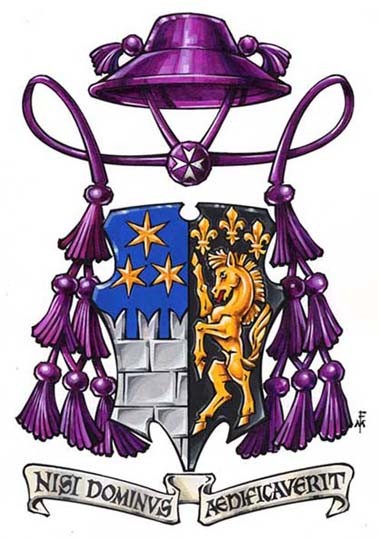
The Heraldry of Sacred Music by Duane L.C.M. Galles


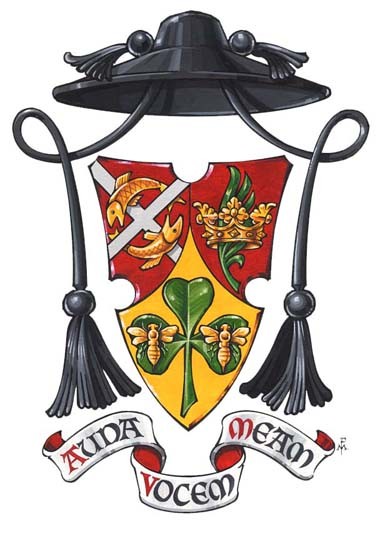
 Heraldic artwork and images courtesy Marco Foppoli

Our Catholic faith neglects nothing. 

And the visual beauty and communication of the art and science of heraldry is no exception.

So, here's something intriguing: a series of 4 articles on "the Heraldry of Sacred Music" by Duane LCM Galles.

We are very pleased to re-direct readers to this series of articles published in the Document Library of EWTN.

Part 1 here

Part 2 here

Part 3 here

Part 4 here

The Heraldry accompanying this post is by the magnificent Marco Foppoli the Italian heraldic artist whose reputation is growing enormously.  And justifiably so.  Any of you out there considering Heralidic art or heraldic design should consider his services.

We point out that the second coat of arms above is that of none other than Fra' Richard Divall AO, OBE, the Melbourne-based Australian Knight of Justice in the Sovereign Military Hospitaller Order of St John of Jerusalem of Rhodes and of Malta (the Order of Malta).  As a Knight of Justice, he is a Professed Religious and, heraldically speaking, as a religiou he foregoes the helm and crest to which he is entitled retains his shield (the real "coat of arms") and surrounds it with a rosary (note the cross used is the Maltese Cross of the Order).