Sunday, 8 July 2018

Matthew Festing, Grand Master of the Knights of Malta | Financial Times

Matthew Festing, Grand Master of the Knights of Malta | Financial Times

Matthew Festing, Grand Master of the Knights of Malta

The ex-soldier leads a Catholic fraternity that was founded in the 11th century and carries out humanitarian work in 120 countries

Matthew Festing, His Most Eminent Highness The Prince and Grand Master of the Knights of Malta, in his study © Alberto Bernasconi

The private residence of the Grand Master of the Knights of Malta is perched high above the Ligurian Sea on a rocky promontory near Rapallo and within view of the mouth of Portofino harbour.

A Maltese Cross flies from the battlements of Villa Pagana, or Villa Malta, as the locals have called it since the 1950s, when the Spinolas, a family of princely merchants, entrusted it to the world's oldest surviving chivalric order.

The Sovereign Military Hospitaller Order of Saint John of Jerusalem of Rhodes and of Malta (to give it its full name) is an enigmatic Catholic religious fraternity founded in 1048.

Despite having no territory, it is considered a sovereign entity under international law, printing its own postage stamps and coins.

A butler, in a white jacket with gold buttons, leads me into the salone, where I await His Most Eminent Highness The Prince and Grand Master of the Knights of Malta, also known as Matthew Festing, a former Grenadier Guardsman from Northumbria in England.

I was briefed to "present formally", as befitting an encounter with a head of state but, disappointingly, Festing is in mufti, consisting of a blue jacket and green trousers, rather than his ceremonial black cloaking.

The former Sotheby's consultant took possession of the ochre villa — surrounded by maritime pines and an exotic garden of cacti, palms and orange bird-of-paradise flowers — in 2008 when he was appointed as the order's 79th Grand Master. Festing was elected for life in a secret ballot at a papal-style conclave in Rome and has both a ceremonial and decision-making role overseeing its humanitarian activity. He does not draw a salary although his living costs are met.

Piranha

Festing plays down the grandeur. "You would think, gosh, it's an enormous house, you can have 25 people to stay, but you'd be pushed to have more than six. It's a family home really."

Aged 66, he has not married or had children — as one of about 60 professed knights, he has taken a vow of celibacy, as well as of poverty and obedience. But his great-nieces and nephews visit in the summer, playing in the tower and cruising in his 1960s Ligurian fishing boat.

The villa was built in the early 1600s, with a watchtower as defence against any attack from French-Piedmontese troops. An antique brass telescope stands at a first-floor window, pointing out to sea as if anticipating a raid.

Historically, members of the order have been descended from European nobility. Festing traces his family back to 14th-century knights. His ancestor, Sir Adrian Fortescue, a cousin of Anne Boleyn, was executed because he refused to sign an oath acknowledging Henry VIII as "Supreme Head" of the Church in England instead of the Pope.

We sit amid 17th-century Genovese furniture looking through wooden doors on to the chequered-floor terrace and the sea beyond. The room is replete with chandeliers, portraits of regional nobility and antique oddities, including a stuffed turtle and a harpsichord.

Behind a curtain is a chapel with red silk walls, six carved wooden pews, a green-painted altar and a spectacular view. Which for the local priest who says mass there every morning might be part of the attraction.

There are two staircases, the servants' and the grand, both leading to the first floor where "Aeneas' Escape from Troy" by the Neapolitan painter Luca Giordano (1634-1705) hangs in Festing's office. "Gloomy but extraordinary," he says. Previously it was on the dining room ceiling. "It was absolutely black but when it was cleaned all sorts of funny things appeared, like a dog in the bottom left-hand corner."

Villa Pagana near Rapallo, Italy © Alberto Bernasconi
Observatory room © Alberto Bernasconi
Salone © Alberto Bernasconi

Paintings were Festing's first love during his years as Sotheby's representative in Northumbria — he once found an unknown painting by Constable of a garden. "It was an extraordinary find. She, a perfectly ordinary lady, was the descendant of Constable's neighbour, a Mr Gardener. Constable must have painted it and given it to him. So it was Mr Gardener's garden."

Festing, a hospitable fellow, offers a splendid lunch, saying grace in Latin before and after. We are served bresaola, orange and grapefruit salad, followed by saffron risotto with osso buco and then cheeses, accompanied by white wine.

The order was founded when a group of knights established a hospital to tend people of all faiths. The motives of these warrior monks were "complicated", Festing admits. "Some were on a religious high, others were simply short of land."

Because of their military training, the original knights also acted as a Christian militia, defending pilgrims from attack. They were driven out of Jerusalem in 1291, settling in Rhodes and then Malta, which they ruled until they were forced out by Napoleon in 1798.

Its territory lost, the order is now headquartered in Rome and draws on its charitable rather than military roots, operating humanitarian relief and medical missions in more than 120 countries. Almost 100,000 people work with and for the order, including more than 80,000 as volunteers. "It's bigger than the British army," Festing points out.

Festing in the little drawing room © Alberto Bernasconi
Drawing room © Alberto Bernasconi
Dining room © Alberto Bernasconi

Some of its 25,000 doctors, nurses and paramedics run older people's homes in England, schools for autistic children in France and homes for people affected by leprosy in Brazil. The order has been at the forefront of Europe's refugee crisis, providing doctors on Italian coastguard vessels rescuing migrants in the Mediterranean. It also runs 70 emergency shelters and 30 registration centres with medical and legal facilities for refugees in Germany.

The order's property portfolio pays for its central administration in Italy, but worldwide operations are decentralised and run by individual associations. Work is funded by donors such as the EU, government and international agencies as well as individuals — more than 1m in Germany and 1m in France. "They might be a little old lady who gives you five euros and they might be Mr Big who gives you 10,000 euros."

As a sovereign entity, the order has a network of embassies, permitting diplomatic relations with 104 countries. Like Palestine, another stateless sovereignty, it has observer status at the UN. This unusual place in international politics, together with its mysterious practices and rituals, has provoked no shortage of Dan Brown-style conspiracy theories over the years, with some claiming that the order is a shadowy clique of modern-day Crusaders with a Christian supremacist agenda.

In 2008 the order was accused of links to Blackwater, the mercenary security group, a connection Festing's predecessor robustly denied. There have also been (rebutted) claims that the former US commander in Afghanistan, General Stanley McChrystal, was a member. The order has had to face wild accusations from conspiracy theorists of orchestrating everything from the assassination of John F Kennedy to the Iraq war.

In reality the order's influence has been overstated, says Festing, and it doesn't cut much ice with politicians. It is "a complicated thing" he admits. Having embassies provides the order with direct "access" to government. "We don't just [have ambassadors] for the hell of it. But because it facilitates other work. Say you want to get pharmaceuticals through without export duties, or if equipment gets stuck at customs for months, you might be able to use access to negotiate."

Harpsichord in the salone © Alberto Bernasconi
Chapel with red silk walls and six carved wooden pews © Alberto Bernasconi
The chequered-floor terrace looks out over the Ligurian Sea © Alberto Bernasconi

Festing seems believable possibly because he looks and sounds like someone you might see in cricket whites at a village match in England, or the kindly headmaster of a prep school. He enjoys country pursuits. The Field magazine is lying on the hall table. He certainly doesn't look or sound like the head of a Masonic cabal, pulling the strings of the world order.

The organisation has been part of Festing's life "always, since I was a child". After reading history at St John's College, Cambridge, he joined the Grenadier Guards with tours of duty in the Gulf, Northern Ireland and Belize. On leaving the army he was "recruited" to work for the order by his uncle.

The potential for adventure was likely to have been a draw. Festing drove emergency supplies to Bosnia by convoy during the 1990s conflict. He was often required to move in improbable worlds. As part of a series of schemes to help abandoned women in the Balkans to support their families, he trundled around the north of England sourcing curlers and hairbrushes to enable them to start hairdressing businesses. "There was something very odd about that." Under the same scheme he found himself "on the periphery of a chicken-breeding operation. The whole thing was quite peculiar."

His present role involves "going round thanking people, encouraging people and trying to show an interest in what they are doing".

Although Festing holds the status of a cardinal, the order is separate from the Vatican thanks to a 12th-century decree guaranteeing its independence. Nevertheless, the pope emeritus Benedict XVI — "not God's Rottweiler, he's God's teddy bear" — is close to the order, although it was Pope Francis who put Festing's predecessor — Andrew Bertie, a fellow Englishman and a distant cousin of the Queen — on the first step of the ladder to sainthood, which will happen if/when two miracles are attributed to him. "He is on the very, very, very bottom rung," Festing says. Yet before I can ask whether he is likely to follow the same path, he cuts me off. "We're very different."

Photographs: Alberto Bernasconi

Matthew Festing, Grand Master of the Knights of Malta | Financial Times

Matthew Festing, Grand Master of the Knights of Malta | Financial Times

Matthew Festing, Grand Master of the Knights of Malta

The ex-soldier leads a Catholic fraternity that was founded in the 11th century and carries out humanitarian work in 120 countries

Matthew Festing, His Most Eminent Highness The Prince and Grand Master of the Knights of Malta, in his study © Alberto Bernasconi

The private residence of the Grand Master of the Knights of Malta is perched high above the Ligurian Sea on a rocky promontory near Rapallo and within view of the mouth of Portofino harbour.

A Maltese Cross flies from the battlements of Villa Pagana, or Villa Malta, as the locals have called it since the 1950s, when the Spinolas, a family of princely merchants, entrusted it to the world's oldest surviving chivalric order.

The Sovereign Military Hospitaller Order of Saint John of Jerusalem of Rhodes and of Malta (to give it its full name) is an enigmatic Catholic religious fraternity founded in 1048.

Despite having no territory, it is considered a sovereign entity under international law, printing its own postage stamps and coins.

A butler, in a white jacket with gold buttons, leads me into the salone, where I await His Most Eminent Highness The Prince and Grand Master of the Knights of Malta, also known as Matthew Festing, a former Grenadier Guardsman from Northumbria in England.

I was briefed to "present formally", as befitting an encounter with a head of state but, disappointingly, Festing is in mufti, consisting of a blue jacket and green trousers, rather than his ceremonial black cloaking.

The former Sotheby's consultant took possession of the ochre villa — surrounded by maritime pines and an exotic garden of cacti, palms and orange bird-of-paradise flowers — in 2008 when he was appointed as the order's 79th Grand Master. Festing was elected for life in a secret ballot at a papal-style conclave in Rome and has both a ceremonial and decision-making role overseeing its humanitarian activity. He does not draw a salary although his living costs are met.

Piranha

Festing plays down the grandeur. "You would think, gosh, it's an enormous house, you can have 25 people to stay, but you'd be pushed to have more than six. It's a family home really."

Aged 66, he has not married or had children — as one of about 60 professed knights, he has taken a vow of celibacy, as well as of poverty and obedience. But his great-nieces and nephews visit in the summer, playing in the tower and cruising in his 1960s Ligurian fishing boat.

The villa was built in the early 1600s, with a watchtower as defence against any attack from French-Piedmontese troops. An antique brass telescope stands at a first-floor window, pointing out to sea as if anticipating a raid.

Historically, members of the order have been descended from European nobility. Festing traces his family back to 14th-century knights. His ancestor, Sir Adrian Fortescue, a cousin of Anne Boleyn, was executed because he refused to sign an oath acknowledging Henry VIII as "Supreme Head" of the Church in England instead of the Pope.

We sit amid 17th-century Genovese furniture looking through wooden doors on to the chequered-floor terrace and the sea beyond. The room is replete with chandeliers, portraits of regional nobility and antique oddities, including a stuffed turtle and a harpsichord.

Behind a curtain is a chapel with red silk walls, six carved wooden pews, a green-painted altar and a spectacular view. Which for the local priest who says mass there every morning might be part of the attraction.

There are two staircases, the servants' and the grand, both leading to the first floor where "Aeneas' Escape from Troy" by the Neapolitan painter Luca Giordano (1634-1705) hangs in Festing's office. "Gloomy but extraordinary," he says. Previously it was on the dining room ceiling. "It was absolutely black but when it was cleaned all sorts of funny things appeared, like a dog in the bottom left-hand corner."

Villa Pagana near Rapallo, Italy © Alberto Bernasconi
Observatory room © Alberto Bernasconi
Salone © Alberto Bernasconi

Paintings were Festing's first love during his years as Sotheby's representative in Northumbria — he once found an unknown painting by Constable of a garden. "It was an extraordinary find. She, a perfectly ordinary lady, was the descendant of Constable's neighbour, a Mr Gardener. Constable must have painted it and given it to him. So it was Mr Gardener's garden."

Festing, a hospitable fellow, offers a splendid lunch, saying grace in Latin before and after. We are served bresaola, orange and grapefruit salad, followed by saffron risotto with osso buco and then cheeses, accompanied by white wine.

The order was founded when a group of knights established a hospital to tend people of all faiths. The motives of these warrior monks were "complicated", Festing admits. "Some were on a religious high, others were simply short of land."

Because of their military training, the original knights also acted as a Christian militia, defending pilgrims from attack. They were driven out of Jerusalem in 1291, settling in Rhodes and then Malta, which they ruled until they were forced out by Napoleon in 1798.

Its territory lost, the order is now headquartered in Rome and draws on its charitable rather than military roots, operating humanitarian relief and medical missions in more than 120 countries. Almost 100,000 people work with and for the order, including more than 80,000 as volunteers. "It's bigger than the British army," Festing points out.

Festing in the little drawing room © Alberto Bernasconi
Drawing room © Alberto Bernasconi
Dining room © Alberto Bernasconi

Some of its 25,000 doctors, nurses and paramedics run older people's homes in England, schools for autistic children in France and homes for people affected by leprosy in Brazil. The order has been at the forefront of Europe's refugee crisis, providing doctors on Italian coastguard vessels rescuing migrants in the Mediterranean. It also runs 70 emergency shelters and 30 registration centres with medical and legal facilities for refugees in Germany.

The order's property portfolio pays for its central administration in Italy, but worldwide operations are decentralised and run by individual associations. Work is funded by donors such as the EU, government and international agencies as well as individuals — more than 1m in Germany and 1m in France. "They might be a little old lady who gives you five euros and they might be Mr Big who gives you 10,000 euros."

As a sovereign entity, the order has a network of embassies, permitting diplomatic relations with 104 countries. Like Palestine, another stateless sovereignty, it has observer status at the UN. This unusual place in international politics, together with its mysterious practices and rituals, has provoked no shortage of Dan Brown-style conspiracy theories over the years, with some claiming that the order is a shadowy clique of modern-day Crusaders with a Christian supremacist agenda.

In 2008 the order was accused of links to Blackwater, the mercenary security group, a connection Festing's predecessor robustly denied. There have also been (rebutted) claims that the former US commander in Afghanistan, General Stanley McChrystal, was a member. The order has had to face wild accusations from conspiracy theorists of orchestrating everything from the assassination of John F Kennedy to the Iraq war.

In reality the order's influence has been overstated, says Festing, and it doesn't cut much ice with politicians. It is "a complicated thing" he admits. Having embassies provides the order with direct "access" to government. "We don't just [have ambassadors] for the hell of it. But because it facilitates other work. Say you want to get pharmaceuticals through without export duties, or if equipment gets stuck at customs for months, you might be able to use access to negotiate."

Harpsichord in the salone © Alberto Bernasconi
Chapel with red silk walls and six carved wooden pews © Alberto Bernasconi
The chequered-floor terrace looks out over the Ligurian Sea © Alberto Bernasconi

Festing seems believable possibly because he looks and sounds like someone you might see in cricket whites at a village match in England, or the kindly headmaster of a prep school. He enjoys country pursuits. The Field magazine is lying on the hall table. He certainly doesn't look or sound like the head of a Masonic cabal, pulling the strings of the world order.

The organisation has been part of Festing's life "always, since I was a child". After reading history at St John's College, Cambridge, he joined the Grenadier Guards with tours of duty in the Gulf, Northern Ireland and Belize. On leaving the army he was "recruited" to work for the order by his uncle.

The potential for adventure was likely to have been a draw. Festing drove emergency supplies to Bosnia by convoy during the 1990s conflict. He was often required to move in improbable worlds. As part of a series of schemes to help abandoned women in the Balkans to support their families, he trundled around the north of England sourcing curlers and hairbrushes to enable them to start hairdressing businesses. "There was something very odd about that." Under the same scheme he found himself "on the periphery of a chicken-breeding operation. The whole thing was quite peculiar."

His present role involves "going round thanking people, encouraging people and trying to show an interest in what they are doing".

Although Festing holds the status of a cardinal, the order is separate from the Vatican thanks to a 12th-century decree guaranteeing its independence. Nevertheless, the pope emeritus Benedict XVI — "not God's Rottweiler, he's God's teddy bear" — is close to the order, although it was Pope Francis who put Festing's predecessor — Andrew Bertie, a fellow Englishman and a distant cousin of the Queen — on the first step of the ladder to sainthood, which will happen if/when two miracles are attributed to him. "He is on the very, very, very bottom rung," Festing says. Yet before I can ask whether he is likely to follow the same path, he cuts me off. "We're very different."

Photographs: Alberto Bernasconi

Friday, 6 July 2018

RORATE CÆLI: Original Sin: A Sermon

RORATE CÆLI: Original Sin: A Sermon

Original Sin: A Sermon

By Father Konrad zu Loewenstein, FSSP

Sermon delivered on the Fourth Sunday after Pentecost, 2018

My dear people, if the clergy has taught certain doctrines for well nigh 2000 years and has now stopped teaching them, this can only be a consequence of the fact that the are no longer considered 'relevant'. But when we examine them in detail we discover in fact that they are of essential importance, concerning, as they do, Eternal Life and how to attain it, as well as Eternal Damnation.

Examples of these doctrines are:

That the Devil exists; that Hell exists and is eternal; that if some-one dies in mortal sin, he will go to Hell; If someone dies in the state of Grace, by contrast, he will go to Heaven, or to Purgatory and then to Heaven. Examples of mortal sin are impure acts of all types (including that which is alone and contraception), blasphemy, Holy Communion in a state of mortal sin, the concealment of a mortal sin in Confession (To be mortal, we note, a sin must of course be committed in full awareness with deliberate consent).

Further examples: there is only one Faith and only one Religion and that is the Catholic Faith and Religion. Only these will lead to Heaven. There is only one Church and that is the Catholic Church: the rest are all false and do not lead to Heaven. Yes, there is only one Church, my dear people, and that is our glorious Catholic Church: Immaculate, Sinless, infallible, and the Possessor of all Truth. There is no salvation outside the Catholic Church (extra Ecclesiam non est salus).


The meaning of life is the sanctification of the soul, there is no other meaning. To this end, Faith and Grace are necessary and the practice of the virtues, of which one of the most glorious is chastity. Necessary also is mortification, penance, merits, and prayer. Of great importance is the prayer of meditation (and I do not mean the Buddhist type), contemplation, and the practice of the presence of God. Indulgences are also of great value for our sanctification. Grace brings with it the most Blessed Trinity into the soul. God loves each person with an unequal love, according to the person's degree of sanctity, or in other words amiability: the better the person, the more God loves him/her, and the higher degree of glory that person will receive for all eternity in Heaven.

Why are such doctrines no longer considered 'relevant'? Because they are 'negative'. Devil, Hell, sin, Purgatory, mortification; the thought that not all will be saved, that the other 'religions' are not salvific; that some are better than others and so on, are evidently disturbing, and represent a challenge for a carefree, sweet and easy life-style where it's enough to be 'nice', and where Heaven is like this life, only better.

Among the doctrines no longer preached is the doctrine of Original Sin. This doctrine is considered eminently negative, in its relation to Death, suffering, Hell, the Devil, Fallen Nature, the necessity for asceticism and so forth. And yet because it has been preached by the Church always (up till recently) and everywhere, and because of its necessary connection to defined Dogmas, such as the necessity of baptism for salvation and that of the Immaculate Conception, must itself be considered infallible.

The Bible Commission set up by Saint Pius X, one of the very greatest Saints of modern, and indeed, of all times, declared that the account of Original Sin in Genesis must be taken in a literal sense in regard to the following elements:

1. God issued a commandment to the first man to make trial of his obedience;

2. The man transgressed the commandment, seduced by the Devil under the form of a serpent;

3. The first parents were excluded from the original state of innocence.

The first thing to note, my dear people, is that Adam and Eve are real people, the first parents of the entire human race. The human race does not descend from different couples in different places, but from one couple, this couple; it does not descend from a series of apes either. I should hardly need to say this...but I shall.

When the Bible Commission tells us that they were "excluded from the state of innocence" what does this mean? To understand the effects of Original Sin, we must first understand the nature of Original Innocence. Adam and Eve had received certain gifts which transcend the entire capacity of human nature, namely:

a) Supernatural Grace - which unites man to God;

b) the capacity neither to suffer or to die;

c) clarity of intellect and strength of the will;

d) the complete control of all the inferior faculties of the soul, that is to say the movements of the mind and the senses: the passions and the emotions.

All this they lost for themselves; and because they acted as representatives of the whole human race, they lost also for the whole human race. My dear people, just think of the significance of this doctrine. Without Original Sin we would never have had to suffer, nor to die. We would have been in complete control of all our emotions, with a clear intelligence and a strong will. As it is, we are conceived without Grace; we suffer and we die; we find it hard to understand, to exercise our will; we recoil from hardships; our feelings and emotions assail us like spoiled children in search of gratification (as St. John of the. Cross puts it) - anger, fear, lust, despair, inept joy, sadness, the inordinate desire to see, to know, and to possess. A further consequence of Original Sin is our subjection, at least in part, to the Devil's influence and power.

Looked at another way, we could ask ourselves why God would have created man with all such defects? The question is often asked in regard to suffering, but it can equally well be asked in regard to death, an entirely abhorrent process, and the disordered emotions and appetites. The answer is of course that God created everything good, as we read in Genesis, but man, by his sin, introduced into it a principle of degradation.

The other day, my dear people (if you will excuse a biographical note) I was travelling in a train across Switzerland. Outside: the beautiful green countryside, hills and trees, lakes and mountains. Inside, rather less beautifully, a quotation written on a sort of frieze on the wall of the train: "Human nature is good", signed Jean-Jacques Rousseau (a modern so-called 'thinker', of the so-called "Enlightenment" - where we may say in the words of Holy Scripture: "Light is put for darkness and darkness for light").

Human nature, my dear people, is not good, or not wholly good. It is fallen and corrupt - not totally, as the heresiarch Martin Luther was pleased to opine, but partly corrupt. Human nature retains its orientation to God as absolute Truth and absolute Good, but it is disordered and has acquired properties and tendencies which distance it from Him - from Truth and Goodness - and attach it to the self, to the finite and limited things of this world - to possessions, to information, to self-gratification and pride, all of which lead in the end only to imperfections, sin, Hell, and nothingness.

The present age, my dear people - we only have to look around us - represents the final blossoming of Fallen Nature in an incommensurable flower of evil, exuding everywhere its poisonous, asphyxiating miasma. "Human nature is good" cry forth its 'thinkers', its fallen masses with their dead and sorrowing eyes, their drugs, their labyrinthine promiscuity, their gender "theories", their massacre of the innocents, their music and all their arts characterized by a singular lack of harmony and Divine order. "Human nature is good" echo the psychiatrists, deftly taking their fees, as they seek to assuage the disordered passions of their clients with worldly maxims, somniferents and anti-depressants, as though peace and happiness were merely a question of the choice of the right pill.

And the Churchmen of to-day in general, my dear people, are silent, but should you wish to enter a theology library and go to the section on Spirituality, you would find a complete consensus on the part of all the Churchmen of the past on this point, as well as all the Fathers and Doctors of the Church and all the Saints that have ever lived.

Human nature is fallen. Our task is to combat it with discipline and patience, and to pursue the opposing tendency of the soul which leads to God; to re-orient the soul to the True and the Good, to bring it back to life and heal and illuminate it with Grace and all the sacraments; to practice the Cardinal virtues of prudence, justice, fortitude, and moderation - and especially in that part of moderation which is chastity; to combat the weakness of the intellect and the will, and our recoiling from hardships, and all our disordered passions; to grow in Faith, Hope and Charity so that as a result of our discipline and patience, the lower faculties of the soul may be again subjected to the higher faculties - to the intellect and the will -, and the intellect and the will subjected to Faith, and Faith subjected to God.

The consequence will be that the soul, now well-ordered, will be at peace, which in this world is the greater part of happiness; and under the guidance of Faith, Hope and Charity will find ever less bitterness even in suffering and in death - those two profound bodily wounds inflicted on us by Adam.

"The creation is subject to vanity" says St Paul in to-day's Epistle, "it groans and gives birth even up to now...We too groan, even though we have already begun to reap the spiritual harvest waiting for the adoption of the sons of God: the redemption of our body in Christ Jesus Our Lord". We are subject to vanity because having lost the clarity of intellect and the strength of will, we are drawn by our senses and emotions towards nothingness and the void. We groan because we suffer in this life: we groan like a woman in child-labour, labouring as we are to give birth to a new life, the life of glory. This life exists in us already, but we must bring it to its term, to its perfect fruition in Heaven.

This we do by the work of discipline on ourselves that I have attempted to outline, whereby our soul, ordered to God, may sail in calm across the dangerous paths of the earthly ocean to the harbour of eternal blessedness, as we pray with the sublime and sovereign words in to-day's Collect: "Grant we beseech thee O Lord, that the course of this world may peacefully be directed for us in Thine order, and that the Church may rejoice in tranquil devotion, through Christ Our Lord, Amen".

For the Feast of St. Ephraem, the following day

"There will be a time when they will not bear sane doctrine, but will heap up masters according to their desires, itching with their ears, and will avert their hearing from Truth and turn to fables." So the Epistle of to-day, my dear faithful, for the Feast of the Doctor of the Church St. Ephraem, the Syrian.

Is St. Paul not also speaking about our present time? Catholic doctrines are no longer taught, are considered negative: the Devil, Hell, mortification, even discipline. Instead new ideas: the Church is not necessary, all Religions lead to God, we'll all be saved anyway, no-one goes to Hell, or it doesn't exist, or it's empty anyway... after all God is good. God is good, we're all good, human nature is good, X or Y is good - alright they're living together unmarried, but they're good. Impurity? What's that got to do with it? They're not harming anybody, are they?

New teachers: Teilhard de Chardin, a Jesuit priest, preaching Pantheism: All is God. God is the World. We are in evolution to becoming God. The Cosmic Christ. Darwin: We came from the apes, from "pre-hominids". It sounds scientific, does it not?. So what are we, then? Apes or God? or apes becoming God?

New ideas and new teachers heaped up according to our desires, so that we can do what we like. After all we are apes - or God. Morally it comes to the same thing. And self-professed Catholics believing such things, itching with their ears for novelties, turning from Truth to fables... turning from the Truth which is God: Being Itself, the Most Holy Trinity, together with all the Catholic dogmas which are centered on Him; turning to fables: constructs of the intellect, figments of the imagination, born of passing desires, castles in the air, vapour in the air dispelled by the rays of the morning sun, insubstantial, transient, leaving nothing behind, like arrows passing through the air around which the air closes again, or like the furrows of a ship in the boundless ocean, passing, falling away, dissolving into nothingness.

And this rather than a life based on reality: on the Truth that is God, on the Rock that is Christ, in the house which will not fall in the tempest, in the boat which alone will survive the inundation, leading a serious, disciplined life according to reality, according to the objective canons of the True and the Good, amassing treasures in Heaven where moths will not enter, nor rust, nor thieves, but which with our patience, discipline, and sacrifice will ensure our eternal inheritance in the eternal Heart of God, with Our Blessed Mother, St. Ephraem, Doctor of the Church, and all the angels and saints.

May the Holy Name of Jesus be praised forever! Amen.

Thursday, 21 June 2018

Catholic? Why? | Fr. Z's Blog

Catholic? Why? | Fr. Z's Blog

Catholic? Why?

Quotes from the article that follows:

  • Freely to assent to truth is the heart of what it means to be civilized.
  • A human order is built on fidelity to tradition and principle.
  • While there are signs of life in various places in the Church, a survey of the whole, to be frank, is rather bleak.
  • In the past several years, I have perceived a noticeable loss of intellectual acumen that the Church gained with John Paul II and Benedict.
  • Things that once seemed unchangeable are now changed or expected to change in the near future.
  • Under the aegis of finely tuned "mercy" and "discernment," a method has been developed that would justify this accommodation of the Church to that modernity and its principles that everyone seems eager to embrace.
  • Many wonder whether the Church does not now see itself as simply a this-worldly socio-political movement instrumental primarily in curing our temporal ills.
  • Indeed, it seems like we find two Churches holding contradictory views within the same Church.
  • The primary argument that the Church teaches the same things over time does not seem valid for many any longer.
  • What is new is the worry that radical changes have been made in an official way that would cause us to doubt the integrity of the original revelation.

At Crisis:

Why Be (or Continue to Be) Catholic?
REV. JAMES V. SCHALL, S.J.

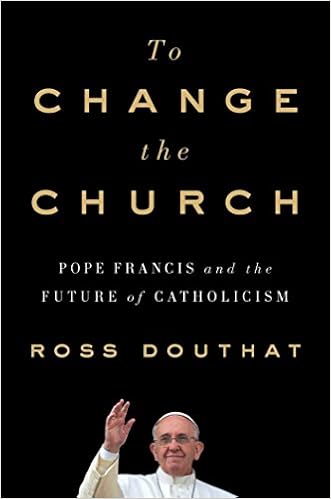
On a recent book review TV interview program called Q/A, Ross Douthat, author of To Change the Church, was asked about his own beliefs. He responded quite frankly that he was a Catholic. When asked why, Douthat replied that, as far as he could see, a divine intervention did take place in this world around the time and appearance of Christ. He added that the essence of this intervention has been best preserved down the subsequent ages by the Catholic Church. This sensible view is one that many Catholics would also accept as valid for them. Indeed, probably the best way to see this view of the divine intervention spelled out step by step is in Benedict's Jesus of Nazareth. After reviewing most of the scholarly literature on this topic, Benedict concluded that the evidence seems to show that Christ was "who He said He was."

But few are much concerned with the intellectual facts of the matter. Something else is going on. Not many really seem to worry about the truth of these issues, though that is where the real drama lies. Freely to assent to truth is the heart of what it means to be civilized. [Isn't it interesting that libs try to force people to deny the truth in front of your face?] In a way, however, our culture is beyond truth. We make up our own universe. The Supreme Court tells us it is our "right." Such a development, wherein we impose our ideas on reality rather than let reality instruct us about what it is, usually means to opt for one or other current fantasy or ideology that is custom-designed to explain away things that we choose not to accept, no matter what evidence can be given for them.

Many millions of words have now been written about the meaning of the Irish abortion vote, one foreshadowed by a similar change in Quebec decades ago. In both cases, areas that had been proudly Catholic for centuries, suddenly decided to ditch its tradition to join the secular world, its principles and practices. Such a radical change in these cultures had already taken place, just as Plato thought, in the souls of the citizens of these areas. From that viewpoint, the change was not so surprising. A human order is built on fidelity to tradition and principle. It is not immune to change as if it were a material object. Indeed, reasonable change is part of its stability.

Likewise, many Catholic churches, orphanages, hospitals, and schools in Europe and America are closed. Muslims are willing to move into these edifices if allowed to do so. [I know a concrete case like this in my native place.  What an outrage.] Many famous churches have long been national monuments or museums under government support. I read somewhere that, on visiting the churches in Dublin, the only people there were American tourists, often looking for their ancestors. While there are signs of life in various places in the Church, a survey of the whole, to be frank, is rather bleak. Whether Scripture or tradition gives us many grounds for expecting anything too much different is doubtful. Christ himself asked the disciples whether, on his return, they thought there would be faith on earth (Luke 18, 7-8). This passage is always a testimonial to the powers that are in constant opposition to what Christ put into the world.

In the past several years, I have perceived a noticeable loss of intellectual acumen that the Church gained with John Paul II and Benedict. Many are upset by this lack of depth, especially more recent converts who came into the Church with the help of the vigorous thinking we still see in these two popes. But the main reason for the decline of Church membership is the desire to be like others in modern society. Many want Catholic teaching to be viewed and interpreted through a modern lens. [The lib, modernist agenda: reduction of the supernatural to the natural, conformation to the world.]

We no longer speak of "heretics." [Isn't that the case??  Just try the word "heretic" and people run around with their hair on fire and spout virtue signals.] Heretics insist on staying in the Church so that they can change it from the inside. On the surface, everybody is nice, [But only on the surface.  Scratch a lib….] with a "right" to his own opinion. Nothing seems definite, precisely so that nothing binds. In the end, freedom of opinion ends up with everyone having mostly the same opinions, now politically enforced. Things that once seemed unchangeable are now changed or expected to change in the near future. The clergy and the bishops are not much help as they seem—to many at least—to betray the same symptoms.

II.

In the light of these comments, in spite of scandals and confusions in Rome, we still need to ask: "Why should we continue to be Catholic?" Much of the controversy that swirls around the Holy Father has, at its origin, the feeling that certain basic—once-thought non-negotiable—principles and practices have been denied or at least implicitly allowed to pass away. Under the aegis of finely tuned "mercy" and "discernment," a method has been developed that would justify this accommodation of the Church to that modernity and its principles that everyone seems eager to embrace.

Recent remarks and decisions, often coming from Archbishop Luis Ladaria, the current Prefect of the Congregation of the Doctrine of Faith, however, have been more careful. We have seen a firm statement that women cannot be priests. The German formula for the interfaith communion at a wedding is set aside. A renewed interest in the centrality of doctrine appears in CDF documents. These are welcome signs. The dubia are still not answered. Good Catholics are still seen as rigid. The papacy often appears to act in the public eye like a political party of the left. Christianity is seen as a force to lead sundry crusades over ecology, poverty, or immigration. Such initiatives are difficult to square with good economics, science, and politics.

Not a few have also pointed out that an indirect papal input in the various pro-abortion and gay marriage votes in Ireland and Portugal occurred when Catholics were advised to deal with more "important" things. Their enemies, to give them credit, do not think these issues are among the lesser important things. Many wonder whether the Church does not now see itself as simply a this-worldly socio-political movement instrumental primarily in curing our temporal ills. The irony is that the methods recommended in these areas have almost invariably, when tried, made things worse. We do find considerable talk of sanctity and holiness but again this is often of an activist kind. The contemplative life, the life that is needed to keep our souls in touch with the transcendent, seems to be minimized.

III.

Let us ask again: "Why be, or continue to be, Catholic today?" The only sensible reason is that what the Church teaches is true to its immediate origin in the divinity itself. Has the Church on any major issue contradicted its own mandate? This is a delicate point. Only the Church believes that it is the sole deposit of this mandate.

In thinking about these things, I again take my cue from the "heretics" who refuse to leave the Church but stay in it to transform it, as they say, into their image of modernity. In the end, they can find no place else to go. They are already wrapped within modernity's orbit. The effort from within to transform Christianity into modernity, to align its basic premises with those of the modern world, seems like a plausible, shrewd tactic. Many have already made this transition.

The Catholics who remain in the Church because the Church is consistent over time with its founding often find themselves perplexed. Practically no one is excommunicated for holding any position associated with modernity. They see people, in apparent good standing, continuing in the Church who accept and practice most of the aberrations of modern social living. Indeed, it seems like we find two Churches holding contradictory views within the same Church. The division liberal/conservative is practically useless as a way to understand the difference. The issue is a matter of truth, not interpretation.

To many, both inside and outside the Church, there seems to be much ecclesiastical confusion. Upsetting new interpretations constantly appear. Previously, many considered the Church wrong, but no one thought it did not hold or articulate what it affirmed on basic points of practice and doctrine. The primary argument that the Church teaches the same things over time does not seem valid for many any longer. [This is the position of Kasper and Co., who have replaced philosophy with politics.  Over time the truth can change.] The same things do not seem to be taught and affirmed in its many dioceses, schools, seminaries, and institutions. Various attempts have been made to explain how the Church can be both loyal to its tradition and, without contradiction, accept the basic premises of modernity.

For instance, Jesus was said in his time to look at current events and see what needed to be changed. So he changed them according to what was needed at the time. "Loyalty" to tradition thus means doing the same for our time. First we do what needs to be done; then we can develop a theory to justify it. The word "discernment" has come to mean the ability to see almost directly into temporary things or situations the action of the Holy Spirit. On the basis of what we think we discern, we can act with confidence that we are not following our own wills but that of the Holy Spirit.  [Note how libs talk about the "spirit-filled church" over and against the "institutional" Church.]

Or we can say that we do not know exactly what Jesus said or did.  [Like a certain head of the Jesuits, who cast doubt on just about every word of Christ because they didn't have tape recorders back then.] He really did not lay down basic principles that needed to be maintained over time to protect the authenticity of his teaching and revelation. He was merciful and compassionate. The best we can do is to read the "signs of the times" and accommodate ourselves to where the Spirit is leading all men into the future. This approach would allow us to put aside our "absolutes" and embrace the pastoral changes that the culture has already put into place.

However plausible these positions may seem, if indeed they do seem plausible, they clearly avoid facing the central issue of whether a definite revelation in Christ was to be maintained for the human good down the ages in spite of persecution, disagreement, and other cultural conditions in other places and times.

Can we continue to be Catholic today? Only if one thing remains true and upheld. Only if the same teachings and practices that were handed down and guaranteed down the ages remain the basis of what the Church is. This revelation in all its ramifications is what best explains human meaning and destiny. If the substance of this revelation is not upheld, the question is no longer a merely human problem of loyalty to a tradition. It is the breakdown of revelation itself since it is no longer credible on its own terms. The guarantee of Christ is to be with us till the end, with the central teachings and practices of his life at the center. If this content and sequence is not maintained in a living way, in a thoroughly nuanced but plain way, we really have no reason still to be Catholic.

What is unusual about our time is not opposition to or rejection of the truth of this revelation. Adversaries have been found in every era. What is new is the worry that radical changes have been made in an official way that would cause us to doubt the integrity of the original revelation. At least some of us can still affirm with Douthat that a divine intervention did take place in Christ and that it is best preserved in the Catholic Church. The same intervention also gives us the criterion for judging when it is itself not credible—namely when the Church as guardian of revelation clearly changes its own truths and does not uphold them before the nations down the ages. This is why contemporary writers like Douthat carefully watch for changes that take place in Roman. [sic – that's how it ends.  It could be "… in Rome."]

Fr. Z kudos to Fr. Schall for this sober and sobering comment.

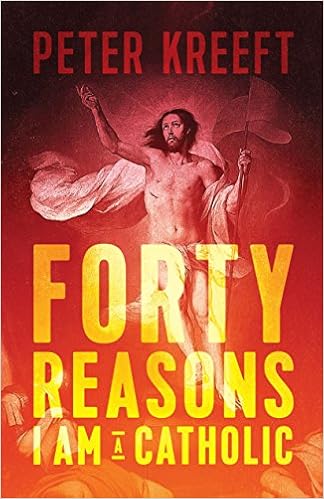
It seems appropriate also to post a reminder about a recent book by Peter Kreeft.

Forty Reasons I Am A Catholic

US HERE – UK HERE