Well, it has been awhile and a lot has happened, but we will be returning to this blog and giving our observations on events and liturgical matters.
It has been a tumultuous time since the sede vacante - it always is, isn't it? - and the time that has elapsed has given us cause and pause for thought about the direction of things, including things liturgical, which is the subject of preference for this blog.
There is much we could comment on, and will, but let us start by re-affirming our prayerful loyalty to His Holiness Pope Francis. Ad multos annos!
We already prayer for the now Pope Emeritus, Benedict XVI, for whom we pray that there is consolation and support from all in this unique service His Holiness maintains for the Church and the People of God.
Sunday, 29 June 2014


Saturday, 9 March 2013
Sede Vacante MMXIII
Today, the Conclave, to elect a new Roman Pontiff, following the abdication of His Holiness, Pope Benedict XVI, has been set for Tuesday 12 March 2013.
We pray that the Holy Spirit may guide the Cardinal-Electors in their voting and deliberations and that they may follow the promptings of the Paraclete.
We give thanks for the reign of Benedict XVI, we thank him for all his teaching, his clarity of expression, his prayer and, dear to us here, his re-orienting of the liturgical debate and celebrations. He give particular thanks for all his initiatives in particular Summorum Pontificum, Anglicanorum Coetibus and his efforts to correct the interpretation of the Second Vatican Council as in continuity with all that came before. We pray for him always, with eternal gratitude, as he prays for us.
We pray that the Holy Spirit may guide the Cardinal-Electors in their voting and deliberations and that they may follow the promptings of the Paraclete.
We give thanks for the reign of Benedict XVI, we thank him for all his teaching, his clarity of expression, his prayer and, dear to us here, his re-orienting of the liturgical debate and celebrations. He give particular thanks for all his initiatives in particular Summorum Pontificum, Anglicanorum Coetibus and his efforts to correct the interpretation of the Second Vatican Council as in continuity with all that came before. We pray for him always, with eternal gratitude, as he prays for us.
Tuesday, 25 December 2012

Thursday, 26 April 2012
The Heraldry of Sacred Music by Duane L.C.M. Galles
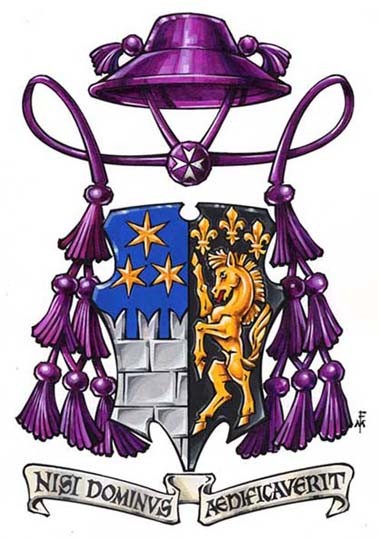


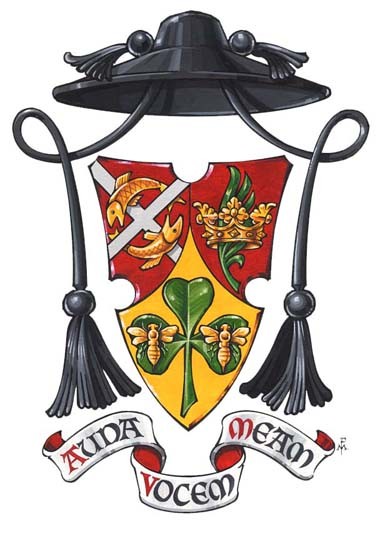

Our Catholic faith neglects nothing.
And the visual beauty and communication of the art and science of heraldry is no exception.
So, here's something intriguing: a series of 4 articles on "the Heraldry of Sacred Music" by Duane LCM Galles.
We are very pleased to re-direct readers to this series of articles published in the Document Library of EWTN.
Part 1 here
Part 2 here
Part 3 here
Part 4 here
The Heraldry accompanying this post is by the magnificent Marco Foppoli the Italian heraldic artist whose reputation is growing enormously. And justifiably so. Any of you out there considering Heralidic art or heraldic design should consider his services.
We point out that the second coat of arms above is that of none other than Fra' Richard Divall AO, OBE, the Melbourne-based Australian Knight of Justice in the Sovereign Military Hospitaller Order of St John of Jerusalem of Rhodes and of Malta (the Order of Malta). As a Knight of Justice, he is a Professed Religious and, heraldically speaking, as a religiou he foregoes the helm and crest to which he is entitled retains his shield (the real "coat of arms") and surrounds it with a rosary (note the cross used is the Maltese Cross of the Order).
Wednesday, 25 April 2012
New Reform of the Reform Mass at St Aloysius Caulfield
News comes to us that from 12 May, St Aloysius in Caulfield will offer a SaturdayVigil Mass each Saturday at 6pm to be celebrated in a Reform of the Reform style. This fulfils the Sunday Obligation.
The special Reform of the Reform website says:
The promulgation of the new translation of the Roman Missal of 1970, invites us to reflect further on the "hermeneutic of continuity" articulated by Pope Benedict XVI, and the importance of this being demonstrated consistently in the celebration of the Ordinary Form of the Roman Rite.
Beginning Saturday 12th May (at 6 pm), in response to the requests of the Faithful, a weekly Vigil Mass in the Ordinary Form will be offered at St Aloysius' Church which will aim to exemplify "sacredness in continuity".
The Mass will be celebrated in English, "ad orientem" at the High Altar, with both the Propers of the day and the Ordinary being sung. Communicants are invited to kneel at the Altar rails to receive Our Lord on the tongue 'under both kinds' by intinction. Books will be provided containing all the readings, Mass Ordinary and Propers, and music including hymns.
The inaugural Mass, at 6 pm on Saturday 12th May, will be offered for the intentions of Pope Benedict XVI.
We commend the good Fathers in their initiative in responding to the requests of the Faithful.
This initiative has received some comment over on David Schutz's blog.
We posted the following comment today in response to the question whether Glorificamus has been involved:
The special Reform of the Reform website says:
The promulgation of the new translation of the Roman Missal of 1970, invites us to reflect further on the "hermeneutic of continuity" articulated by Pope Benedict XVI, and the importance of this being demonstrated consistently in the celebration of the Ordinary Form of the Roman Rite.
Beginning Saturday 12th May (at 6 pm), in response to the requests of the Faithful, a weekly Vigil Mass in the Ordinary Form will be offered at St Aloysius' Church which will aim to exemplify "sacredness in continuity".
The Mass will be celebrated in English, "ad orientem" at the High Altar, with both the Propers of the day and the Ordinary being sung. Communicants are invited to kneel at the Altar rails to receive Our Lord on the tongue 'under both kinds' by intinction. Books will be provided containing all the readings, Mass Ordinary and Propers, and music including hymns.
The inaugural Mass, at 6 pm on Saturday 12th May, will be offered for the intentions of Pope Benedict XVI.
We commend the good Fathers in their initiative in responding to the requests of the Faithful.
This initiative has received some comment over on David Schutz's blog.
We posted the following comment today in response to the question whether Glorificamus has been involved:
"Joshua / Oliver
No, The Glorificamus Society has not been involved in sponsoring this initiative.
However, we heartily support this initiative: anything which helps to promote the sense of the sacred, the transcendent and offering of Holy Mass in continuity with tradition should be warmly supported and welcomed by all. The Holy Father is clear in what he wants and why it’s good for the Church.
The good Fathers at St Aloysius are doing magnificent work for those who wish to worship in the Extraordinary Form.
This new initiative seems to us to offer something important to the Archdiocese in exemplifying the offering Holy Mass in the vernacular using options that are in continuity with tradition, especially:
- the use of Ad Orientem is the key intiative; would that more parishes actually adopt it for at least some Masses and at the High Altar (where there is still one or if there isn’t one, install one)
- the singing of the Propers: the key musical step is the recovery of Gregorian Chant propers, the real way to sing the Catholic Mass
- we presume the singing of the Ordinary is also Gregorian and hopefully allow for the recover the People’s Chant, something denied to most congregations around Australia
- kneeling to receive Holy Communion on the tongue: a key expression of our faith in our Eucharistic Lord.
All good. Let’s get behind it and show our support. Clearly, the Fathers are responding to the requests of the faithful in a generous fashion. May God bless them.
As far as the Masses which Glorificamus has organised, all the above elements have been employed. A notable difference was that the Masses were sung by the Celebrant, people and the lectors in Latin (with the exception of the Prayers of the Faithful).
One can hardly do other than encourage St Aloysius in offering Mass in the way they have chosen: in the context of a parish that offers every Mass in Latin this sounds like a very good way to offer someting attractive to those seeking a reverent Mass in English. We hope it prospers and other parishes learn how to do it too.
The Holy Father was clear that we all have much to learn from the older form of the Mass when it comes to celebrating the newer form well. Perhaps priests from other parishes might attend to see how it’s done and parishioners from other parishes attend and go back to your parishes and ask Father to follow St Aloysius’ example."
Saturday, 7 April 2012
He Has Risen: Easter 2012

I arose and am still with Thee, alleluia: Thou hast laid Thine hand upon me, alleluia: Thy knowledge is become wonderful, alleluia, alleluia. Ps. Lord, Thou has searched me and known Me: Thou knowest my sitting down and my rising up. V. Glory be to the Father...
Friday, 24 February 2012
No Extraordinary Form Mass at St Patrick's Cathderal for 2 weeks; resumes Wednesday 14 March at 5.30pm
Please note that there will be no EF Mass at St Patrick’s Cathedral either this Wednesday (29th February), or the following week (7th March).
The Cathedral Mass will resume on 14th March at the usual time of 5.30pm. Entry to the Cathderal is via the door at the Right Transcept and parking available in the Lansdowne Street Carpark.
The Cathedral Mass will resume on 14th March at the usual time of 5.30pm. Entry to the Cathderal is via the door at the Right Transcept and parking available in the Lansdowne Street Carpark.
Monday, 20 February 2012
Ash Wednesday: Traditional Mass at St Patrick's Cathedral
This Wednesday, 22 February, the Traditional Mass at St Patrick's Cathedral will move to 6.30pm.
This will be this Wednesday only.
This will be this Wednesday only.
Sunday, 25 December 2011
Happy Christmas

Friday, 2 September 2011
Pope Benedict XVI: The Way of Beauty - Via Pulchritudinis - "Sacred music that makes the chords of our heart resound"

From Zenit:
--------------------------------------
Wednesday's Audience
--------------------------------------
On Beauty as a Way to God
Art "Is Like a Door Opened to the Infinite"
CASTEL GANDOLFO, Italy, AUG. 31, 2011 (Zenit.org
(http://livepage.apple.com/)).- Here is a translation of the Italian-language catechesis Benedict XVI gave today during the general audience.
* * *
Dear brothers and sisters,
On several occasions in recent months, I have recalled the need for every Christian to find time for God, for prayer, amidst our many daily activities.The Lord himself offers us many opportunities to remember Him.
Today, I would like to consider briefly one of these channels that can lead us to God and also be helpful in our encounter with Him: It is the way of artistic expression, part of that "via pulchritudinis" -- "way of beauty" -- which I have spoken about on many occasions, and which modern man should recover in its most profound meaning.
Perhaps it has happened to you at one time or another -- before a sculpture, a painting, a few verses of poetry or a piece of music -- to have experienced deep emotion, a sense of joy, to have perceived clearly, that is, that before you there stood not only matter -- a piece of marble or bronze, a painted canvas, an ensemble of letters or a combination of sounds -- but something far greater, something that "speaks," something capable of touching the heart, of communicating a message, of elevating the soul.
A work of art is the fruit of the creative capacity of the human person who stands in wonder before the visible reality, who seeks to discover the depths of its meaning and to communicate it through the language of forms, colors and sounds. Art is capable of expressing, and of making visible, man's need to go beyond what he sees; it reveals his thirst and his search for the infinite. Indeed, it is like a door opened to the infinite, [opened] to a beauty and a truth beyond the every day. And a work of art can open the eyes of the mind and heart, urging us upward.
But there are artistic expressions that are true roads to God, the supreme Beauty -- indeed, they are a help [to us] in growing in our relationship with Him in prayer. We are referring to works of art that are born of faith, and that express the faith. We see an example of this whenever we visit a Gothic cathedral: We are ravished by the vertical lines that reach heavenward and draw our gaze and our spirit upward, while at the same time, we feel small and yet yearn to be filled. Or when we enter a Romanesque church: We are invited quite naturally to recollection and prayer. We perceive that hidden within these splendid edifices is the faith of generations. Or again, when we listen to a piece of sacred music that makes the chords of our heart resound, our soul expands and is helped in turning to God. I remember a concert performance of the music of Johann Sebastian Bach -- in Munich in Bavaria -- conducted by Leonard Bernstein. At the conclusion of the final selection, one of the Cantate, I felt -- not through reasoning, but in the depths of my heart -- that what I had just heard had spoken truth to me, truth about the supreme composer, and it moved me to give thanks to God. Seated next to me was the Lutheran bishop of Munich. I spontaneously said to him: "Whoever has listened to this understands that faith is true" -- and the beauty that irresistibly expresses the presence of God's truth.
But how many times, paintings or frescos also, which are the fruit of the artist's faith -- in their forms, in their colors, and in their light -- move us to turn our thoughts to God, and increase our desire to draw from the Fount of all beauty. The words of the great artist, Marc Chagall, remain profoundly true -- that for centuries, painters dipped their brushes in that colored alphabet, which is the Bible.
How many times, then, can artistic expression be for us an occasion that reminds us of God, that assists us in our prayer or even in the conversion of our heart! In 1886, the famous French poet, playwright and diplomat Paul Claudel entered the Basilica of Notre Dame in Paris and there felt the presence of God precisely in listening to the singing of the Magnificat during the Christmas Mass. He had not entered the church for reasons of faith; indeed, he entered looking for arguments against Christianity, but instead the grace of God changed his heart.
Dear friends, I invite you to rediscover the importance of this way for prayer, for our living relationship with God. Cities and countries throughout the world house treasures of art that express the faith and call us to a relationship with God. Therefore, may our visits to places of art be not only an occasion for cultural enrichment -- also this -- but may they become, above all, a moment of grace that moves us to strengthen our bond and our conversation with the Lord, [that moves us] to stop and contemplate -- in passing from the simple external reality to the deeper reality expressed -- the ray of beauty that strikes us, that "wounds" us in the intimate recesses of our heart and invites us to ascend to God.
I will end with a prayer from one of the Psalms, Psalm 27: "One thing have I asked of the Lord, that will I seek after; that I may dwell in the house of the Lord all the days of my life, to behold the beauty of the Lord, and to inquire in his temple" (Verse 4). Let us hope that the Lord will help us to contemplate His beauty, both in nature as well as in works of art, so that we might be touched by the light of His face, and so also be light for our neighbor. Thank you.
[Translation by Diane Montagna]
[The Holy Father then greeted pilgrims in several languages. In English, he said:]
I am pleased to greet the English-speaking pilgrims and visitors here today, especially those from Scotland and Malta. Today we reflect on the need to draw near to God through the experience and appreciation of artistic beauty. Art is capable of making visible our need to go beyond what we see and it reveals our thirst for infinite beauty, for God. Dear friends, I invite you to be open to beauty and to allow it to move you to prayer and praise of the Lord. May Almighty God bless all of you!
© Copyright 2011 - Libreria Editrice Vaticana
[In Italian, he said:]
Lastly, I address a word of cordial welcome to the Italian-speaking pilgrims. In particular, I greet the bishops who are friends of the Community of Sant'Edigio, the faithful of the various parishes, who are accompanied by their parish priests, and newlyweds. I hope that this meeting strengthens each of you in a renewed adherence to God, fount of light, of hope and of peace.
[After the prayer:]
Thank you, a good day to you all. Thank you!
[Translation by Diane Montagna]
Subscribe to:
Posts (Atom)