Saturday, 5 July 2014

Latin Mass Text: comparing the Novus Ordo with the Traditional Latin Mass text

The call by some Lutherans to restore Latin to the Lutheran liturgy reminded us of the request we often encounter: what exactly is the text of the Novus Ordo in Latin when compared to the Traditional Latin Mass.

To that end, we suggest a visit here for a comparison between the texts of the Novus Ordo and the Traditional Latin Mass.

This comparison reminds us that the production of the Novus Ordo was not a mere translation of the old Mass into the vernacular. The text was a re-writing of the Mass.

You will note the Novus Ordo translation is the ICEL version.

Friday, 4 July 2014

Restore Latin to the Mass. The Lutheran mass, that is.

Really, who would have thought it.

Perhaps, just perhaps, these guys are on to something in this piece on the restoration of Latin to the liturgy of Lutherans.  

If we take every reference to "Lutheran" and substitute for it "Catholic"...

Some very interesting posts

Each of these is well-worth a read.

From the revived Oriens Journal "The Economics of Religion" by Lyle Dunne and "How a Protestant spin machine hid the truth about the English Reformation" by Dominic Selwood of The Telegraph


Monday, 30 June 2014

Current Events in Latin America: The Catholic Church and its decline in Latin America

Given this was to be our first substantive post since returning, we were going to address the events since 2013.  But an interesting set of data on the current events in Latin America covers the decline of the Catholic Church in Latin America - or as others would have it - the collapse of the faith in Latin America, which has been the subject of a post at Rorate Caeli.

Go over there and have a look at the data which comes from Corporacion Latinobarometro's "latest survey of religion in Latin America, real eased on 16 April 2014".  Despite what Rorate calls a "document released to honour the first year of the pontificate of the first Latin American pope, the study has an upbeat tone in the introductory remarks about the strength of religion and of Catholicism in Latin America.  Nevertheless the graphs and statistic present a wholly different story, at least as far as Catholicism is concerned".

Go over and see for yourselves.  What was of interest to us was:

(1) if is curious that anyone might suggest that the level of baptisms would give a reliable indicator of the state of the faith of any population

(2) Rorate is correct to suggest a better measure is "self-identification"

(3) however, it can't be correct for anyone to suggest that mere self-identification is that reliable either, given the often (a) poor formation of so many who classify themselves as Catholic; (b) the outright rejection of basic tenets of the Catholic faith by people who still self-identify as Catholic.  We don't think, by the way, that Rorate is characterising this as a reliable measure.

(4) to give an idea of the scale of the decline: in Nicaragua 47% self-identify as Catholics (down from 77%) and in Honduras 47% down from 76%. These countries dropping to these levels in the space of a single generation, when they were formally overwhelmingly Catholic, they are now majority non-Catholic

(5) The mass conversions of Catholics to Evangelical Protestantism, and - to get to the focus on this blog  - the suggestion that the influence of the Evangelical-style worship which has crept into Catholic liturgy, in fact facilitates and complete movement into Evangelicalism and leaving the Catholic Church behind.

The last is of particular interest: it highlights the dangers in borrowing and developing a "style" of worship that is not rooted in Catholic tradition and, it seems to us, justifications for it that include some concession to "what the people want" or "what attracts people" is misguided, precisely because these "styles" have no foundation in Catholic liturgical tradition.   And this affects the Novus Ordo rather than the Vetus Ordo.

Sunday, 29 June 2014

We're Back

Well, it has been awhile and a lot has happened, but we will be returning to this blog and giving our observations on events and liturgical matters.

It has been a tumultuous time since the sede vacante - it always is, isn't it? - and the time that has elapsed has given us cause and pause for thought about the direction of things, including things liturgical, which is the subject of preference for this blog.

There is much we could comment on, and will, but let us start by re-affirming our prayerful loyalty to His Holiness Pope Francis.  Ad multos annos!

We already prayer for the now Pope Emeritus, Benedict XVI, for whom we pray that there is consolation and support from all in this unique service His Holiness maintains for the Church and the People of God.

Saturday, 9 March 2013

Sede Vacante MMXIII

Today, the Conclave, to elect a new Roman Pontiff, following the abdication of His Holiness, Pope Benedict XVI, has been set for Tuesday 12 March 2013.

We pray that the Holy Spirit may guide the Cardinal-Electors in their voting and deliberations and that they may follow the promptings of the Paraclete.

We give thanks for the reign of Benedict XVI, we thank him for all his teaching, his clarity of expression, his prayer and, dear to us here, his re-orienting of the liturgical debate and celebrations.  He give particular thanks for all his initiatives in particular Summorum Pontificum, Anglicanorum Coetibus and his efforts to correct the interpretation of the Second Vatican Council as in continuity with all that came before.  We pray for him always, with eternal gratitude, as he prays for us.

Tuesday, 25 December 2012

Thursday, 26 April 2012

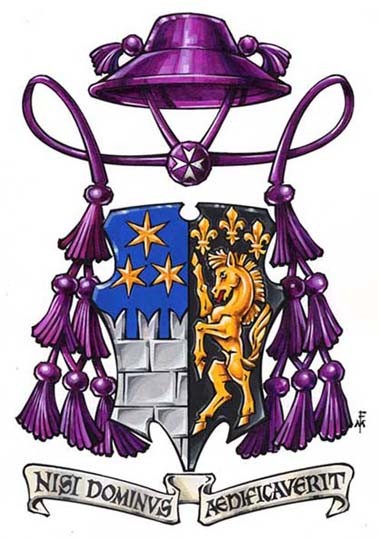
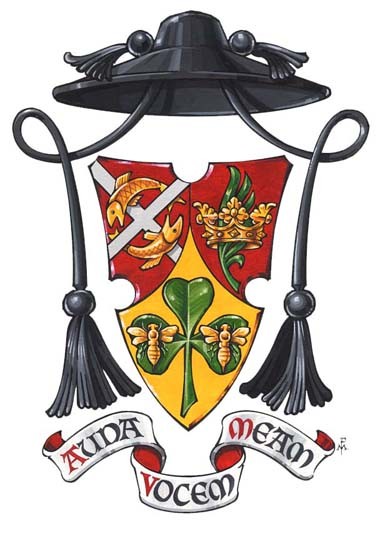
The Heraldry of Sacred Music by Duane L.C.M. Galles


 Heraldic artwork and images courtesy Marco Foppoli

Our Catholic faith neglects nothing. 

And the visual beauty and communication of the art and science of heraldry is no exception.

So, here's something intriguing: a series of 4 articles on "the Heraldry of Sacred Music" by Duane LCM Galles.

We are very pleased to re-direct readers to this series of articles published in the Document Library of EWTN.

Part 1 here

Part 2 here

Part 3 here

Part 4 here

The Heraldry accompanying this post is by the magnificent Marco Foppoli the Italian heraldic artist whose reputation is growing enormously.  And justifiably so.  Any of you out there considering Heralidic art or heraldic design should consider his services.

We point out that the second coat of arms above is that of none other than Fra' Richard Divall AO, OBE, the Melbourne-based Australian Knight of Justice in the Sovereign Military Hospitaller Order of St John of Jerusalem of Rhodes and of Malta (the Order of Malta).  As a Knight of Justice, he is a Professed Religious and, heraldically speaking, as a religiou he foregoes the helm and crest to which he is entitled retains his shield (the real "coat of arms") and surrounds it with a rosary (note the cross used is the Maltese Cross of the Order).

Wednesday, 25 April 2012

New Reform of the Reform Mass at St Aloysius Caulfield

News comes to us that from 12 May, St Aloysius in Caulfield will offer a SaturdayVigil Mass each Saturday at 6pm to be celebrated in a Reform of the Reform style.  This fulfils the Sunday Obligation.

The special Reform of the Reform website says:

The promulgation of the new translation of the Roman Missal of 1970, invites us to reflect further on the "hermeneutic of continuity" articulated by Pope Benedict XVI, and the importance of this being demonstrated consistently in the celebration of the Ordinary Form of the Roman Rite.


Beginning Saturday 12th May (at 6 pm), in response to the requests of the Faithful, a weekly Vigil Mass in the Ordinary Form will be offered at St Aloysius' Church which will aim to exemplify "sacredness in continuity".

The Mass will be celebrated in English, "ad orientem" at the High Altar, with both the Propers of the day and the Ordinary being sung. Communicants are invited to kneel at the Altar rails to receive Our Lord on the tongue 'under both kinds' by intinction. Books will be provided containing all the readings, Mass Ordinary and Propers, and music including hymns.

The inaugural Mass, at 6 pm on Saturday 12th May, will be offered for the intentions of Pope Benedict XVI.


We commend the good Fathers in their initiative in responding to the requests of the Faithful. 

This initiative has received some comment over on David Schutz's blog

We posted the following comment today in response to the question whether Glorificamus has been involved:

"Joshua / Oliver

No, The Glorificamus Society has not been involved in sponsoring this initiative.


However, we heartily support this initiative: anything which helps to promote the sense of the sacred, the transcendent and offering of Holy Mass in continuity with tradition should be warmly supported and welcomed by all. The Holy Father is clear in what he wants and why it’s good for the Church.

The good Fathers at St Aloysius are doing magnificent work for those who wish to worship in the Extraordinary Form.

This new initiative seems to us to offer something important to the Archdiocese in exemplifying the offering Holy Mass in the vernacular using options that are in continuity with tradition, especially:

- the use of Ad Orientem is the key intiative; would that more parishes actually adopt it for at least some Masses and at the High Altar (where there is still one or if there isn’t one, install one)

- the singing of the Propers: the key musical step is the recovery of Gregorian Chant propers, the real way to sing the Catholic Mass

- we presume the singing of the Ordinary is also Gregorian and hopefully allow for the recover the People’s Chant, something denied to most congregations around Australia

- kneeling to receive Holy Communion on the tongue: a key expression of our faith in our Eucharistic Lord.

All good. Let’s get behind it and show our support. Clearly, the Fathers are responding to the requests of the faithful in a generous fashion. May God bless them.

As far as the Masses which Glorificamus has organised, all the above elements have been employed. A notable difference was that the Masses were sung by the Celebrant, people and the lectors in Latin (with the exception of the Prayers of the Faithful).
One can hardly do other than encourage St Aloysius in offering Mass in the way they have chosen: in the context of a parish that offers every Mass in Latin this sounds like a very good way to offer someting attractive to those seeking a reverent Mass in English. We hope it prospers and other parishes learn how to do it too.

The Holy Father was clear that we all have much to learn from the older form of the Mass when it comes to celebrating the newer form well. Perhaps priests from other parishes might attend to see how it’s done and parishioners from other parishes attend and go back to your parishes and ask Father to follow St Aloysius’ example."

Saturday, 7 April 2012

He Has Risen: Easter 2012

RESURREXI, et adhuc tecum sum, allelúia: posuísti super me manum tuam, allelúia: mirábilis facta est sciéntia tua, allelúia, allelúia. Ps. 138. 1- 2. Dómine, probásti me, et cognovísti me: tu cognovísti sessiónem meam et resurrectiónem meam. V. Gloria Patri.

I arose and am still with Thee, alleluia: Thou hast laid Thine hand upon me, alleluia: Thy knowledge is become wonderful, alleluia, alleluia. Ps. Lord, Thou has searched me and known Me: Thou knowest my sitting down and my rising up. V. Glory be to the Father...